 English












How an R188 Deep Groove Ball Bearing Increased Fidget Spinner Spin Time from 1 to 6 Minutes
Sep 23, 2026 0 Dreampower
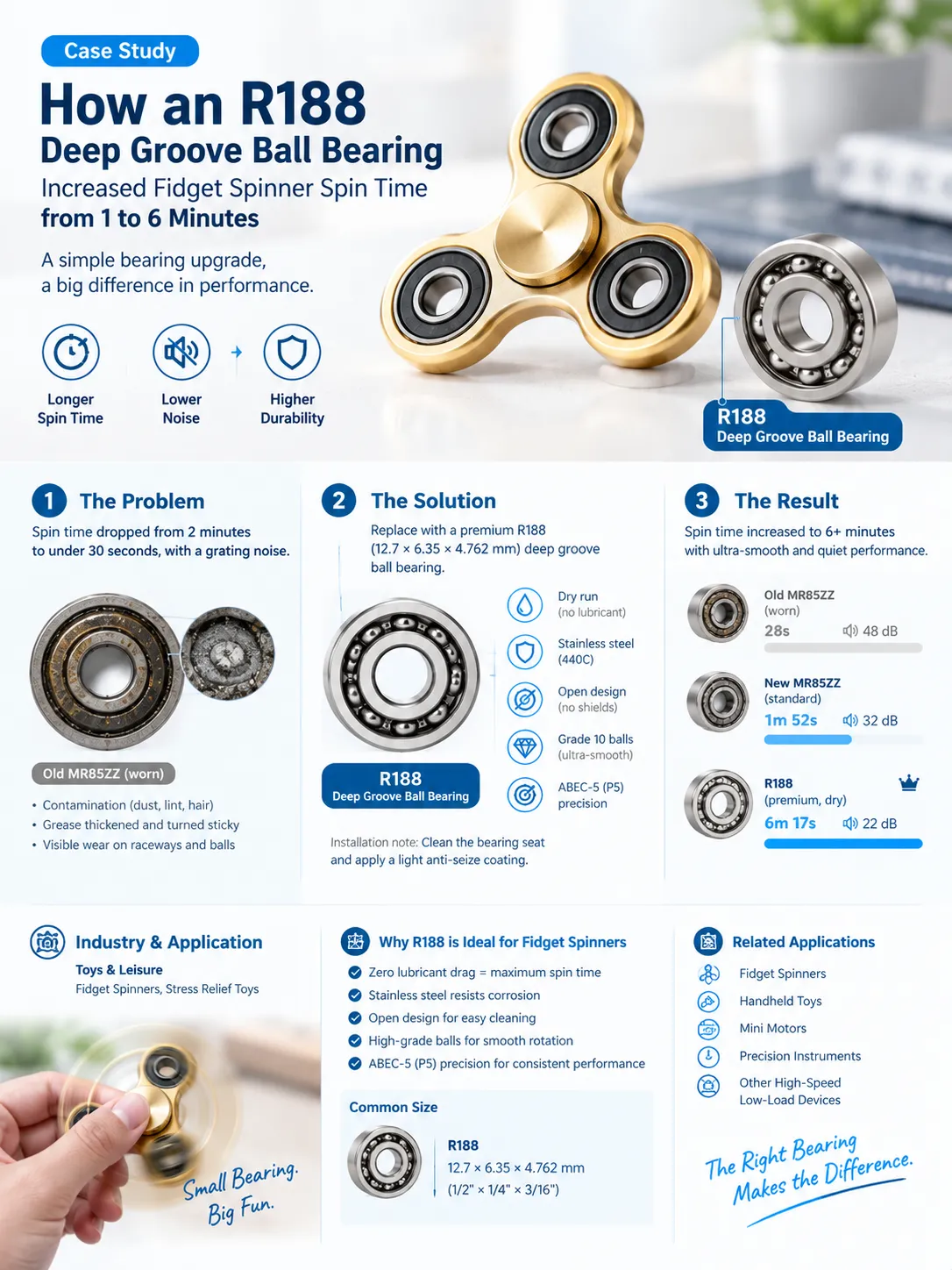
How an R188 Deep Groove Ball Bearing Increased Fidget Spinner Spin Time from 1 to 6 Minutes
Case Study: Improving Fidget Spinner Performance by Replacing a Standard MR85ZZ with a Premium R188 Bearing
In a fidget spinner, bearing friction, lubrication, contamination and precision can have a noticeable effect on spin performance. This case study compares a worn MR85ZZ, a new standard MR85ZZ and a premium R188 deep groove ball bearing under the same test conditions.
1. The Problem
A fidget spinner enthusiast noticed that his brass tri-spinner was no longer performing as it had when new. The spinner originally rotated smoothly for approximately two minutes, but after several months of daily use, the spin time had dropped to less than 30 seconds.
The spinner also produced a noticeable grating sound when the rotation slowed down. The owner attempted to clean the bearing with isopropyl alcohol, but the improvement lasted only about a day before the noise and drag returned.
Main Symptoms
- Spin time reduced from approximately 2 minutes to less than 30 seconds
- Noticeable grating noise during slow rotation
- Increased rotational drag
- Cleaning provided only temporary improvement
2. Inspection & Diagnosis
We disassembled the spinner and removed the original bearing. The spinner was equipped with an MR85ZZ deep groove ball bearing measuring 5 mm × 8 mm × 2.5 mm.
Under magnification, several signs of contamination and wear were identified.
| Possible Issue | Observation |
|---|---|
| Contamination | Hair, dust and lint were found around the shield area. |
| Lubricant condition | The original grease had thickened and become sticky. |
| Raceway wear | Polishing marks were visible on the inner and outer raceways. |
| Ball surface | Minor surface scratches were observed, consistent with debris circulation. |
The combination of contamination, thickened lubricant and wear increased internal friction and rotational drag. For a low-load application such as a fidget spinner, even relatively small changes in bearing friction can noticeably affect spin time.
3. The Solution
Instead of simply cleaning and reinstalling the worn bearing, we tested a premium R188 deep groove ball bearing.
The R188 is an inch-size miniature bearing with dimensions of 1/4" × 1/2" × 3/16", equivalent to approximately 6.35 mm × 12.7 mm × 4.762 mm (ID × OD × Width).
| Bearing Feature | Potential Benefit for Fidget Spinners |
|---|---|
| Dry-running configuration | Eliminates conventional grease drag and can support long free-spin performance when the application permits dry operation. |
| 440C stainless steel | Provides good corrosion resistance for applications exposed to hand sweat and normal handling conditions. |
| Open design | Allows easier access for cleaning and maintenance compared with shielded configurations. |
| High-grade balls | High-quality rolling elements can contribute to smooth rotation and reduced vibration. |
| ABEC-5 / P5 precision | Provides controlled dimensional and running accuracy for applications requiring consistent rotation. |
4. Spin Time Test Results
To compare bearing performance, three bearing configurations were tested under the same conditions. The spinner was placed on a tabletop, spun by hand using approximately the same force, and the timer was stopped when the rotation visibly halted.
| Bearing Type | Average Spin Time | Noise Level | Rotation Feel |
|---|---|---|---|
| Old MR85ZZ Worn |
28 seconds | 48 dB Grating |
Rough and draggy |
| New MR85ZZ Standard |
1 min 52 sec | 32 dB Smooth |
Smooth |
| R188 Premium / Dry |
6 min 17 sec | 22 dB Near silent |
Very smooth |
Test Result: The R188 achieved an average spin time of 6 minutes 17 seconds.
Under the same test conditions, this was significantly longer than both the worn and new standard MR85ZZ configurations.
5. Long-Term Follow-Up
The spinner was used for another three months, including daily pocket carry and occasional drops onto hard surfaces. The R188 bearing was then inspected again.
| Spin time | Approximately 5 min 20 sec |
| Corrosion | No visible rust or corrosion |
| Cleaning result | Cleaning restored spin time to more than 6 minutes under the same test conditions |
The open bearing design also made routine cleaning easier because contaminants could be accessed and flushed out without removing a shield.
6. Which Bearing Is Right for a Fidget Spinner?
Bearing selection depends on the desired balance between spin performance, maintenance, contamination protection and cost.
| Application Priority | Bearing Option | Main Characteristic |
|---|---|---|
| Maximum free-spin performance | R188 | Open, dry-running configuration |
| Lower maintenance | MR85ZZ / MR85-2RS | Shielded or sealed configuration with pre-applied lubrication |
| Cost-conscious applications | MR85ZZ | Compact and widely used miniature bearing configuration |
7. Conclusion
This comparison demonstrates how bearing configuration can influence the free-spin performance of a fidget spinner. In this test, the premium R188 deep groove ball bearing delivered a significantly longer spin time than both the worn MR85ZZ and the new standard MR85ZZ.
Factors such as bearing friction, lubricant selection, bearing precision, contamination and material can all affect performance in low-load, high-speed applications.
For fidget spinner manufacturers and enthusiasts looking for long spin times, the R188 can be an interesting option, particularly when an open, dry-running configuration is suitable for the application.
Looking for R188 Deep Groove Ball Bearings?
Welink Bearing supplies miniature and inch-size deep groove ball bearings for fidget spinners, hobby products, precision mechanisms and other low-load applications.