 English












Power Tool Bearings: Choosing Deep Groove Ball Bearings for Impact & Vibration
Sep 23, 2026 0 Dreampower
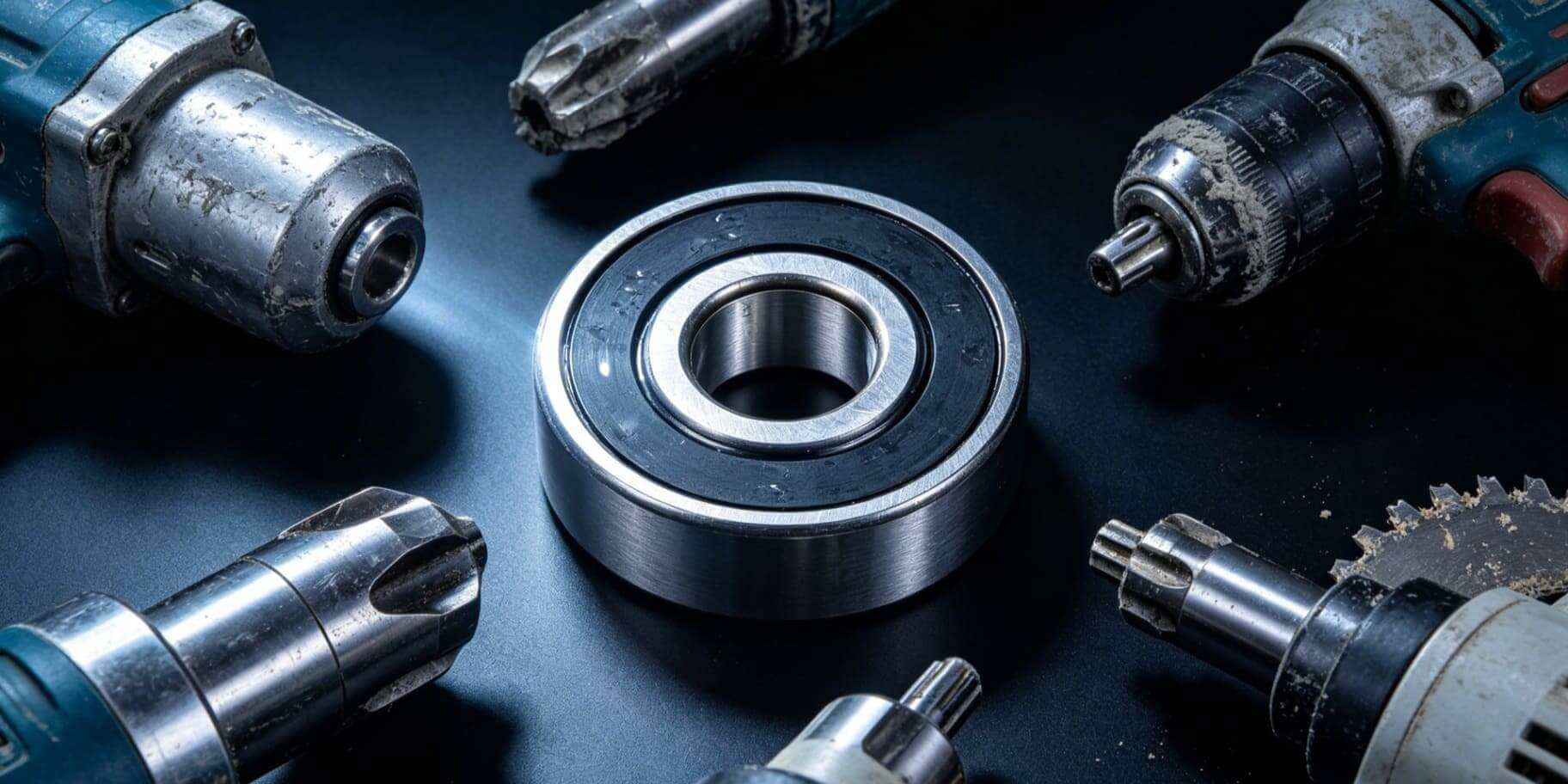
Power tools push mechanical components to their absolute limits. Whether it is an angle grinder cutting through masonry or a hammer drill driving into concrete, the internal components are subjected to extreme speeds, intense vibration, and highly abrasive dust. At Welink Bearing, a manufacturer dedicated to the R&D and production of deep groove ball bearings (DGBB) and miniature bearings, we frequently help technicians and engineers solve premature bearing failure in these harsh environments.
Here is our comprehensive guide on how to specify the right deep groove ball bearings for heavy-duty power tools.
The Quick Answer for Engineers
To ensure longevity in high-impact and high-vibration power tools, choose Deep Groove Ball Bearings (DGBBs) with C3 internal clearance to accommodate rapid thermal expansion. Equip them with contact rubber seals (2RS) to block abrasive metallic and concrete dust, and specify a reinforced cage (such as riveted steel or polyamide) to withstand shock loads. High-temperature synthetic grease filling is essential to prevent lubrication breakdown at high RPMs.
The Extreme Demands on Power Tool Bearings
Unlike standard electric motors, power tools operate under a unique combination of punishing conditions:
• Extreme Speeds: Spindle bearings in angle grinders and routers routinely operate at 10,000 to 30,000 RPM.
• Severe Vibration and Impact: Hammer drills and impact drivers generate continuous axial and radial shock loads that can shatter standard bearing cages or cause raceway brinelling (indentations).
• Abrasive Contamination: Wood dust, concrete powder, and metal shavings constantly threaten to penetrate the bearing and destroy the rolling elements.
• Rapid Heat Generation: High friction in an enclosed housing causes rapid temperature spikes, leading to the thermal expansion of internal steel components.
To overcome these challenges, a standard off-the-shelf bearing is not enough. You must specify your DGBBs based on five critical parameters.
5 Crucial Specifications for High-Vibration DGBBs
① Internal Clearance: Managing Thermal Expansion
When a bearing spins at 20,000 RPM, friction generates significant heat. The inner ring (attached to the hot motor shaft) expands faster than the outer ring. If the bearing has standard internal clearance (CN), this expansion eliminates the internal gap, causing the bearing to seize.
• The Solution: Always specify C3 internal clearance (greater than normal) for high-speed power tools. This extra microscopic space allows the steel to expand without increasing rolling friction, preventing catastrophic failure.
② Sealing Mechanisms: Fighting Abrasive Dust
Contamination is the number one cause of power tool bearing failure. The right shield or seal is a balance between speed capacity and dust protection.
• ZZ (Metal Shields): Good for high speeds and low friction, but they do not form a complete seal. Use these only in relatively clean environments or internal gearboxes.
• 2RS (Rubber Contact Seals): The rubber lip makes physical contact with the inner ring, providing excellent protection against fine concrete and metal dust. This is the mandatory choice for angle grinders and masonry tools, despite a slight reduction in maximum speed capacity.
③ Cage Selection: Absorbing Impact
The cage (retainer) keeps the steel balls evenly spaced. In a high-vibration environment, a weak cage will fracture, destroying the bearing instantly.
• Riveted Steel Cages: The industry standard for heavy-duty applications. They offer high strength and can withstand the aggressive radial loads of circular saws and grinders.
• Polyamide/Nylon Cages (TN9): Increasingly popular in premium power tools. Nylon is flexible and naturally dampens vibration and impact, making it highly effective for hammer drills.
④ Precision and Noise Grades
High-frequency vibration is not just an external factor; a poorly machined bearing generates its own destructive vibration.
• Precision: Choose bearings manufactured to ABEC-3 (P6) or higher tolerances. Tighter tolerances ensure smoother rotation and better load distribution.
• Vibration Grade: Look for V2 or V3 (ZV2/ZV3) noise and vibration grades. These ratings guarantee the raceways have been super-finished to minimize friction and micro-vibrations at peak speeds.
⑤ Specialized Lubrication
A bearing is only as good as its grease. Standard lithium grease thins out and leaks away under the heat of a high-speed grinder. Welink Bearing recommends a polyurea-based or high-temperature synthetic grease, formulated to maintain its viscosity up to 150°C. For optimal performance without causing drag, the bearing should only be filled to 25% - 35% of its internal capacity.
Welink Bearing Solutions: Typical Power Tool Applications
Different tools require different bearing configurations. Here is a quick reference for matching the DGBB to the tool:
| Power Tool | Main Challenge | Recommended DGBB Specs |
| Angle Grinders | Extreme RPMs, heavy metal/stone dust | 2RS seals, C3 clearance, ABEC-3 precision, high-temp grease |
| Hammer Drills | Severe axial impact, concrete dust | Polyamide cage (vibration damping), 2RS seals, C3 clearance |
| Circular Saws | Heavy radial load, wood shavings | Steel cage, ZZ or 2RS (depending on RPM limit), standard or C3 |
| Routers | Ultra-high speed (up to 30,000 RPM) | Light-contact rubber seals, high-precision (ABEC-5), C3 clearance |
Frequently Asked Questions (FAQ)
① What is a Deep Groove Ball Bearing (DGBB)?
A Deep Groove Ball Bearing is the most versatile and widely used type of rolling bearing. It features deep, continuous raceway grooves on both the inner and outer rings, allowing it to support high-speed rotation and handle both radial and axial loads simultaneously.
② Why do my angle grinder bearings keep failing?
Angle grinder bearings typically fail due to dust ingress or overheating. Upgrading to a bearing with 2RS (rubber contact seals) to block abrasive debris, and C3 internal clearance to handle high-speed heat expansion, usually solves this issue.
③ Should I use ZZ or 2RS bearings in a power drill?
For the chuck/spindle end of a power drill exposed to the environment, a 2RS (rubber seal) bearing is required to block dust. For the internal motor bearings housed inside a sealed casing, ZZ (metal shields) are often preferred as they generate less friction at high speeds.