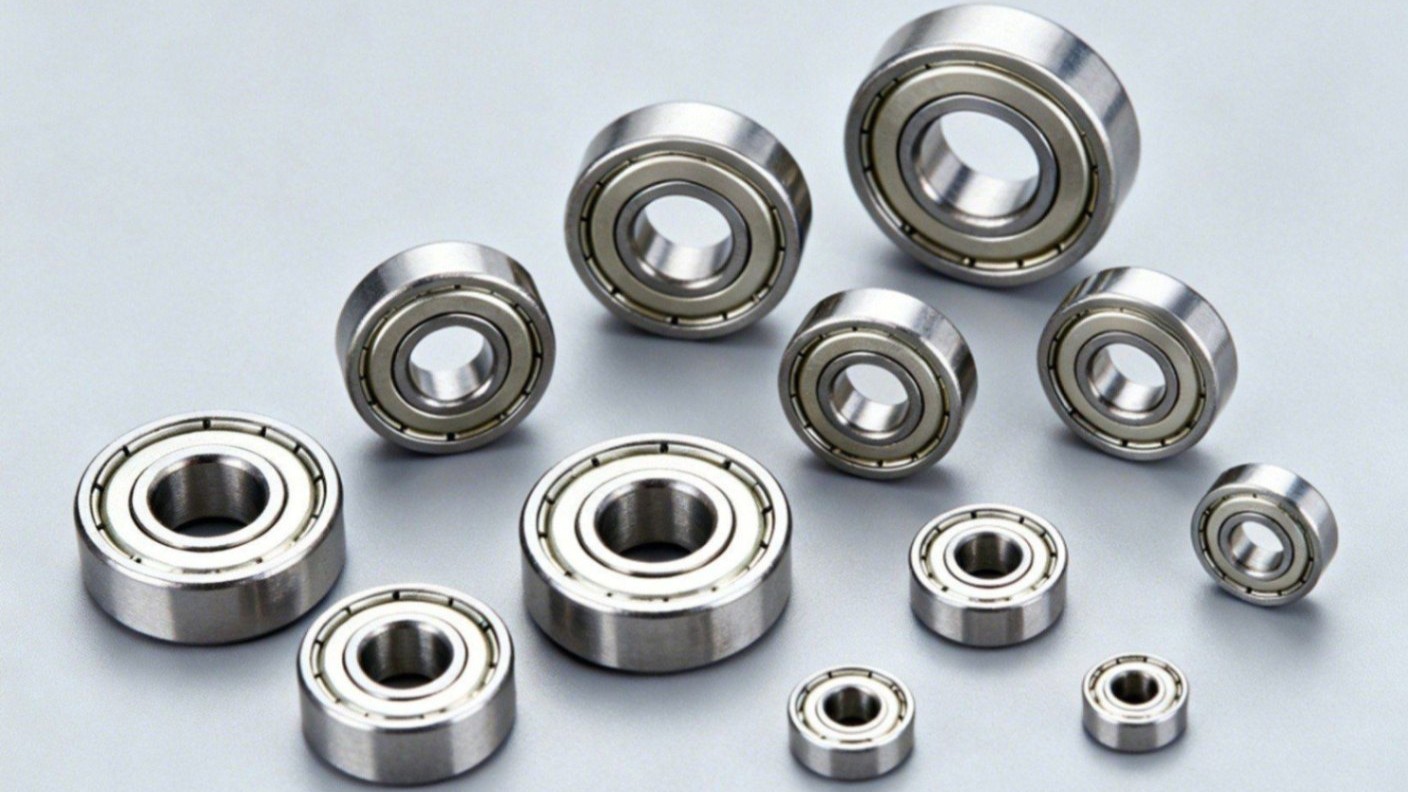
Selecting the right Deep Groove Ball Bearing For An Industrial Motor isn't just a technical detail, it's a critical business decision. A poor choice can silently drain efficiency, increase maintenance costs, and lead to unplanned downtime. If you're specifying bearings for motors in pumps, fans, conveyors, or compressors, you've likely faced the challenge of balancing performance, reliability, and cost. The core of the issue is that motors are not all the same, and neither are their bearings. A bearing perfect for a small appliance motor will fail prematurely under industrial loads, while an over-specified bearing needlessly inflates your project budget. So, how do you navigate the selection process to ensure long-term, trouble-free operation? This guide breaks down the four most common and costly mistakes in industrial motor bearing selection and how to avoid them.

Mistake 1: Choosing the Wrong Series or Size for the Load
One of the most fundamental errors is selecting a bearing based on a familiar part number or available stock, without verifying its load capacity against your application. Industrial motors for pumps or fans experience continuous radial loads. Using a bearing from a lighter series (e.g., a 6000 series) where a medium series (like 6200 or 6300) is required leads to rapid fatigue, brinelling, and early bearing collapse. The result is motor vibration, noise, and ultimately, seizure. Match the bearing series to the operational load. For most general industrial motors, the 6200 series deep groove ball bearing (e.g., 6204, 6206, 6207) offers an excellent balance of radial load capacity and speed capability, making it an industry staple. For applications with heavier loads or higher shaft diameters within a similar housing, stepping up to the 6300 series (e.g., 6308) provides significantly increased load capacity without redesigning the entire assembly. The rule is simple: verify the dynamic and static load ratings against your motor's calculated forces, don't guess.
Mistake 2: Ignoring Precision and Vibration Grades
All bearings are not created equal in terms of manufacturing precision. Using a standard commercial-grade (P0/ABEC-1) bearing in a motor expecting smooth, efficient operation is a false economy. Lower precision bearings have greater tolerances in raceway geometry and ball consistency. This leads to higher internal vibration, increased friction (reducing efficiency), and elevated electrical noise. In variable frequency drive (VFD) motors, this can exacerbate issues with stray currents and bearing currents, causing fluting and premature failure. Specify higher precision grades for critical performance. For industrial motors where efficiency and smooth operation are priorities, P6 grade bearings are a wise investment. Manufacturers like Welink achieve this through precision grinding and 100% vibration screening (e.g., to Z3/V3 group standards). This ensures tighter tolerances, lower torque, and minimised vibration, which directly translates to higher motor efficiency, reduced noise, and longer life for both the bearing and the motor.
Mistake 3: Overlooking Internal Clearance (C-Code)
This is a frequently misunderstood parameter with major consequences. Internal clearance is the total play between the balls and the raceways before installation. A motor bearing operates at elevated temperatures. If a standard clearance (C0) bearing is used, the thermal expansion of the shaft and housing can eliminate this clearance, creating a damaging preload. This causes excessive heat generation, drastically increased friction, and rapid lubricant breakdown, leading to a thermal runaway failure. Select the clearance based on operating conditions. For most electric motors, a C3 clearance is typically recommended. This larger-than-standard operational clearance accommodates the thermal expansion of the system, ensuring the bearing runs with the correct internal play once at operating temperature. For high-precision or special applications, engineers can work with bearing providers to specify even tighter or more bespoke clearance values to optimise performance.
Mistake 4: Selecting the Wrong Sealing and Lubrication
The bearing's internal environment dictates its lifespan. The default choice is not always the right one.
The Problem:
- Seals: An open bearing or one with just a metal shield (ZZ) offers low friction but allows contaminants like dust and moisture to ingress in harsh environments, causing abrasive wear. Conversely, a standard contact seal (2RS) provides good protection but increases starting and running torque, slightly reducing efficiency.
- Lubrication: Using a general-purpose grease that cannot withstand the motor’s operating temperature range will see it either dry out or degrade into a sludge, leaving the bearing unprotected.
The Solution: Tailor the protection to the environment.
- For clean, indoor settings, metal shields (ZZ) or low-friction non-contact seals offer a good balance.
- For most industrial environments (factories, washdown areas, outdoors), rubber contact seals (2RS) are essential for keeping contaminants out and grease in, despite a minimal torque penalty.
- For lubrication, specify a motor-quality, high-temperature grease with anti-wear additives. The right grease will maintain its consistency, resist centrifugal throw-off at high speeds, and protect against corrosion.
How Welink Supports Reliable Motor Design
Avoiding these mistakes requires more than just a catalogue; it requires a partner with manufacturing depth. At Welink, our focus on core industrial series like 6200 and 6300 ensures each bearing is built for the task. Our production is geared for consistency: automated grinding lines and dust-free assembly ensure that every 6204 or 6308 bearing meets strict dimensional tolerances. Every batch undergoes 100% vibration testing, providing the data-backed assurance needed for reliable motor builds. Furthermore, we offer the essential customisation, from P5 precision and C3 clearance to specialised sealing, that allows you to fine-tune a standard bearing to your specific motor's thermal and environmental profile.
The right bearing is an invisible driver of productivity; the wrong one is a liability waiting to fail. By focusing on correct series selection, specifying appropriate precision and clearance, and matching seals and grease to the operating environment, you can eliminate the most common causes of bearing-related motor failure. If you're reviewing a motor design or troubleshooting premature failures, a closer look at the bearing specification is often the most effective step. For a technical consultation or to discuss your specific motor bearing requirements with our engineering team, please contact us at sales@welinkbearing.com.