When engineering a new mechanical system or replacing components in industrial machinery, selecting the correct bearing is paramount. The right choice ensures optimal performance, minimises maintenance costs, and extends the lifespan of your equipment.
Among the most common choices are deep groove ball bearings and tapered roller bearings. While both play crucial roles in reducing friction and supporting loads, they are engineered for vastly different operating conditions.
In this comprehensive guide, we will break down the technical distinctions between the two, highlight the absolute advantages of deep groove ball bearings in specific applications, and help you determine which is the right fit for your project.
① What Are Deep Groove Ball Bearings?
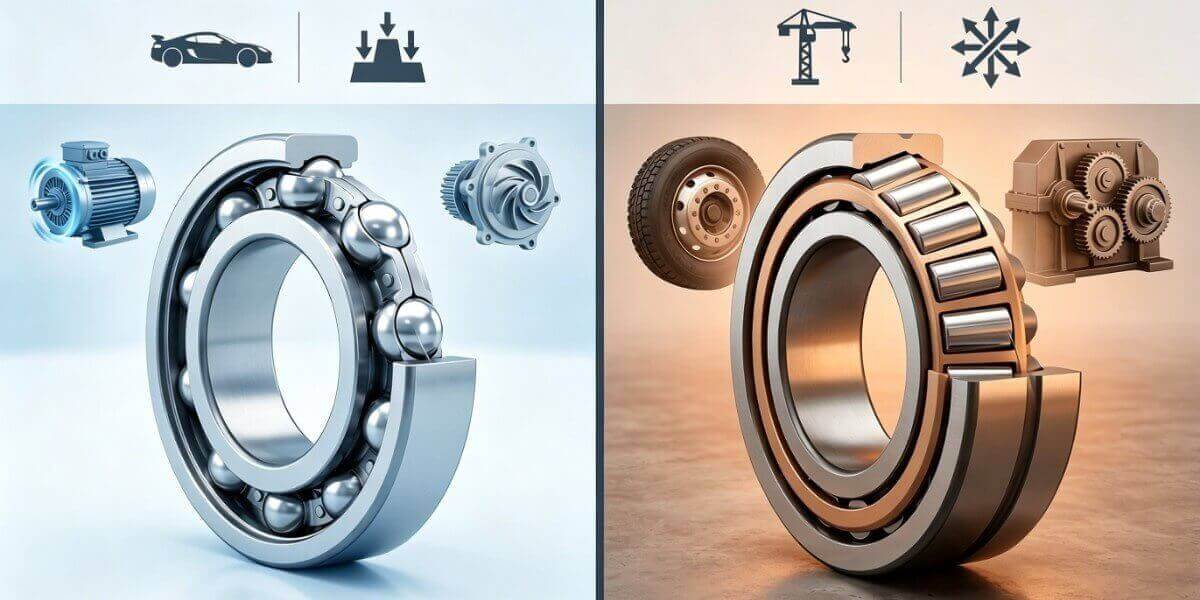
Deep groove ball bearings are the most widely used type of bearing globally, and for good reason. They feature a simple, non-separable design consisting of an inner ring, an outer ring, a cage, and spherical rolling elements (balls).
Because the balls have point contact with the raceways, these bearings produce minimal friction. This design grants them an absolute advantage in high-speed applications.
Key Characteristics:
• Load capacity: Excellent for radial loads; capable of handling moderate axial (thrust) loads in both directions.
• Speed: Exceptionally high rotational speeds.
• Friction & Noise: Low friction, low vibration, and quiet operation.
② What Are Tapered Roller Bearings?
Tapered roller bearings utilise conical rollers guided by a rib on the inner ring. Unlike the point contact of ball bearings, the rollers have line contact with the raceways. This gives them a larger surface area to distribute forces.
They are typically separable (the inner cone assembly and outer cup can be mounted individually) and are engineered specifically to handle heavy, combined loads.
Key Characteristics:
• Load capacity: Exceptional for heavy radial loads and high uni-directional axial loads.
• Speed: Low to moderate rotational speeds.
• Friction: Higher friction compared to ball bearings due to the line contact.
③ Head-to-Head Comparison: Technical Differences
To make an informed decision, it is essential to compare these bearings across several critical performance metrics.
Load Handling: Radial vs. Axial
If your application primarily involves radial loads (forces acting perpendicular to the shaft), deep groove ball bearings are incredibly efficient. They can also accommodate axial loads from both directions, making them highly versatile.
However, if your equipment is subjected to immense, simultaneous radial and axial forces (such as in heavy vehicle wheel hubs), the line contact of a tapered roller bearing is required to prevent material fatigue.
Speed and Efficiency
This is where deep groove ball bearings truly shine. Due to their low-friction point contact, they generate significantly less heat than tapered roller bearings. This allows them to operate at much higher speeds whilst consuming less energy, making them the standard for electric motors, fans, and precision instruments.
Maintenance and Installation
Deep groove ball bearings are often supplied pre-lubricated and sealed (or shielded), essentially making them maintenance-free for the duration of their operational life. Tapered roller bearings, conversely, often require precise clearance adjustments during installation and regular re-lubrication to function correctly.
Quick Reference Table
| Feature |
Deep Groove Ball Bearings |
Tapered Roller Bearings |
| Rolling Element |
Spherical Balls (Point Contact) |
Conical Rollers (Line Contact) |
| Primary Load |
Radial & Moderate Axial |
Heavy Radial & Heavy Axial (One direction) |
| Speed Capability |
Very High |
Low to Moderate |
| Friction Level |
Very Low |
Moderate to High |
| Maintenance |
Low (Often sealed/maintenance-free) |
High (Requires exact adjustment & lubrication) |
| Ideal Applications |
Electric motors, household appliances, pumps |
Gearboxes, automotive wheels, heavy machinery |
④ When Should You Choose Deep Groove Ball Bearings?
You should prioritise deep groove ball bearings if your application demands:
• High-Speed Operations: Such as in electric motors, power tools, or high-speed spindles.
• Energy Efficiency: Where minimising torque and friction is critical to the system's overall efficiency.
• Low Noise and Vibration: Essential for household appliances, HVAC systems, and medical equipment.
• Versatility: When you need a cost-effective, reliable component that can handle general radial loads with occasional axial forces.
⑤ When Should You Choose Tapered Roller Bearings?
Tapered roller bearings are the better choice when your system involves:
• Extreme Heavy Duty Loads: Such as in mining equipment, agricultural machinery, or construction vehicles.
• High Impact Forces: Situations where the bearing must absorb sudden, heavy shocks.
⑥ Why Source Your Bearings from Welink Bearing?
As a manufacturer integrating both R&D and production, Welink Bearing specialises in engineering premium deep groove ball bearings tailored to your exact specifications.
Our absolute focus on this specific category allows us to push the boundaries of speed, load resilience, and longevity. Whether you are manufacturing cutting-edge electric motors or robust industrial pumps, our bearings are rigorously tested to ensure they deliver low friction, low noise, and maximum operational lifespan.
By choosing a specialised manufacturer like Welink, you benefit from direct factory pricing, stringent quality control, and expert technical support that generalist suppliers simply cannot match.
Ready to optimise your machinery? Explore our extensive catalogue of high-performance deep groove ball bearings or contact our engineering team today to discuss customised solutions for your next project.