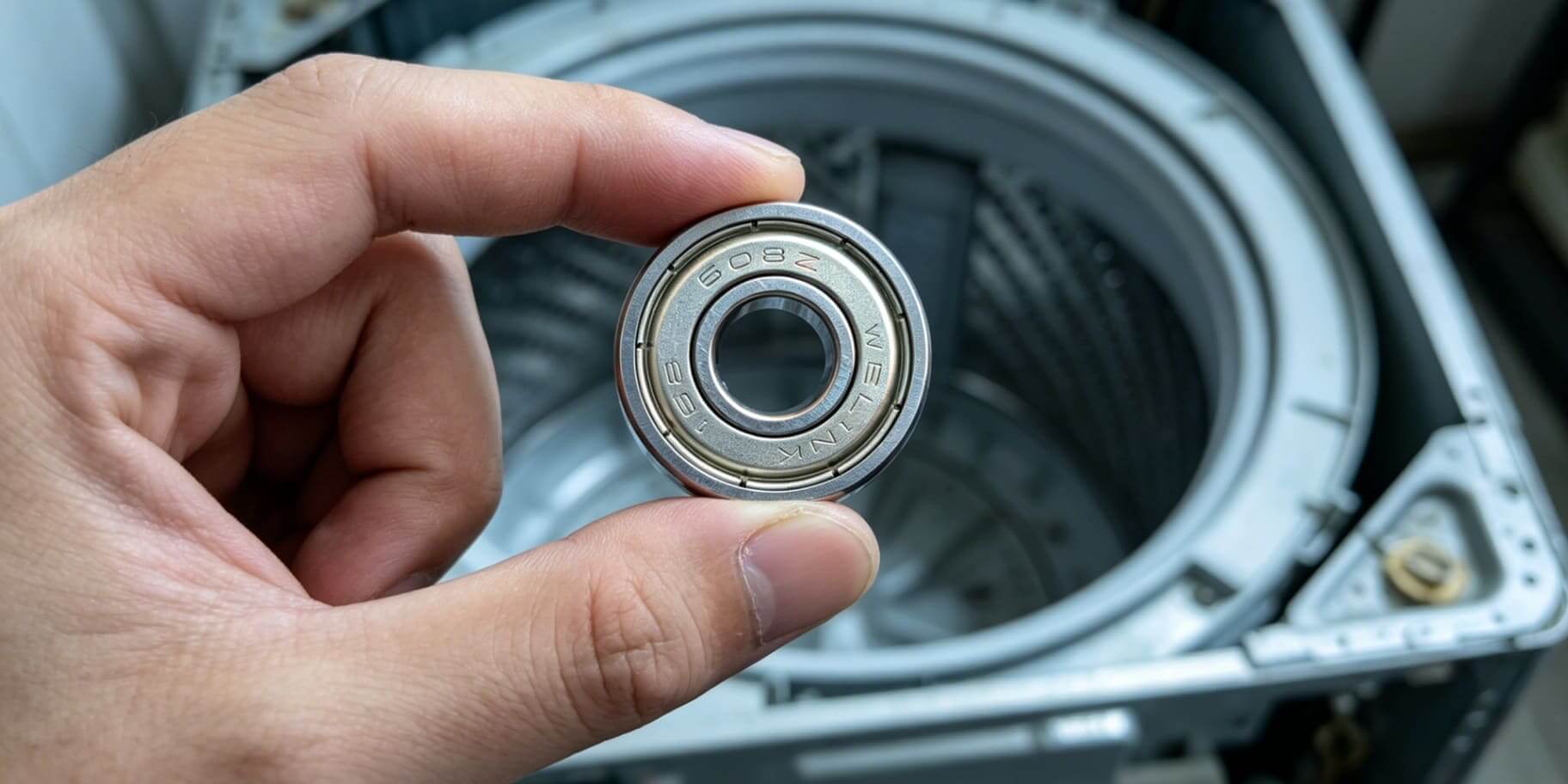
If your washing machine sounds like a jet engine taking off during the spin cycle, chances are the bearing is failing. The good news? Replacing it is much cheaper than buying a new machine. The tricky part is knowing the right bearing size.
Deep groove ball bearings are the most common type used in home appliances. They are small, reliable, and designed to handle both radial and light axial loads. However, different appliances use different sizes and installing the wrong one guarantees it will either not fit or fail quickly.
As experts at Welink Bearing, we have compiled this guide covering the most common bearing sizes for five essential household appliances: washing machines, ceiling fans, vacuum cleaners, electric fans, and power tools. Whether you repair appliances professionally or are tackling a DIY fix, this guide is for you.
① Washing Machines
Washing machine bearings take a lot of abuse. They spin at high speeds, handle unbalanced loads, and are constantly exposed to moisture and detergent. That is why most washing machines use 2RS (rubber seal) bearings; the rubber provides vastly better protection against water and soap compared to ZZ (metal shield) options.
Common washing machine bearing sizes:
| Bearing Model |
Dimensions (d x D x B) |
Seal Type |
Typical Application |
| 6203 2RS |
17 x 40 x 12 mm |
2RS |
Small compact washers |
| 6204 2RS |
20 x 47 x 14 mm |
2RS |
Mid-size front/top load |
| 6205 2RS |
25 x 52 x 15 mm |
2RS |
Large capacity washers |
| 6304 2RS |
20 x 52 x 15 mm |
2RS |
Some drum-type machines |
Pro tip: If your washer is noisy only during the spin cycle, start by checking the bearing. Always inspect the shaft seal as well—if that fails, water enters the bearing and kills it quickly. Replace both at the same time.
② Ceiling Fans
Ceiling fan bearings operate in a clean, dry environment. Because they do not face water or heavy dust, ZZ (metal shield) bearings are the industry standard. The ZZ shield effectively keeps grease in and dirt out, which is perfect for a fan running continuously for years.
Common ceiling fan bearing sizes:
| Bearing Model |
Dimensions (d x D x B) |
Seal Type |
Typical Application |
| 608ZZ |
8 x 22 x 7 mm |
ZZ |
Standard ceiling fan |
| 6000ZZ |
10 x 26 x 8 mm |
ZZ |
Large / heavy-duty fan |
| 626ZZ |
6 x 19 x 6 mm |
ZZ |
Small / mini fan |
Signs of a failing fan bearing include a humming noise, slow starting, blade wobble, or the fan stopping completely. Replacing the bearing is almost always easier and cheaper than replacing the entire motor.
③ Vacuum Cleaners
Vacuum cleaners run at incredibly high speeds often exceeding 30,000 RPM. Standard bearings will overheat and fail quickly in this extreme application. You specifically need bearings rated for high speed, featuring the proper grease and cage design. While most vacuums use ZZ bearings since the housing keeps dust out, the real priority is speed capability, not the seal type.
Common vacuum cleaner bearing sizes:
| Bearing Model |
Dimensions (d x D x B) |
Seal Type |
Typical Application |
| 608ZZ |
8 x 22 x 7 mm |
ZZ |
Small canister vacuums |
| 6000ZZ |
10 x 26 x 8 mm |
ZZ |
Large / upright vacuums |
| 699ZZ |
9 x 20 x 6 mm |
ZZ |
Handheld / portable models |
Warning: Do not use cheap, unbranded bearings in a vacuum cleaner. The high speed will expose any quality issue within hours. Pay close attention to the grease type and internal clearance; high-speed applications often require C3 clearance.
④ Electric Fans (Pedestal / Table / Wall)
Electric fans are simpler than vacuums but still rely on small deep groove ball bearings to run quietly. The absolute most common size is the 608ZZ, which is the same bearing utilized in many ceiling fans and power tools. These bearings usually fail due to dried-out grease or dust bypassing the shield. The symptom progression is predictable: the fan becomes noisy, slows down, and eventually stops.
Common electric fan bearing sizes:
| Bearing Model |
Dimensions (d x D x B) |
Seal Type |
Typical Application |
| 608ZZ |
8 x 22 x 7 mm |
ZZ |
Standard pedestal / table fan |
| 626ZZ |
6 x 19 x 6 mm |
ZZ |
Small desk fan |
Quick fix: If your fan is noisy but still spinning, you can try cleaning out the old grease and repacking it with fresh grease. If the bearing feels rough when turned by hand, replacement is required.
⑤ Power Tools (Drills, Grinders, Saws)
Power tools represent the toughest application on this list. They endure high speeds, severe impact, intense vibration, and heavy dust. Consequently, power tool bearings are usually ZZ (metal shield) and specifically feature C3 internal clearance. This C3 clearance provides extra space inside the bearing to accommodate thermal expansion. Without it, the bearing can easily seize when the tool heats up during heavy use.
Common power tool bearing sizes:
| Bearing Model |
Dimensions (d x D x B) |
Seal Type |
Typical Application |
| 608ZZ |
8 x 22 x 7 mm |
ZZ |
Drill chuck, angle grinder |
| 6000ZZ |
10 x 26 x 8 mm |
ZZ |
Large drills, circular saws |
| 6201ZZ |
12 x 32 x 10 mm |
ZZ |
Heavy-duty industrial drills |
| 626ZZ |
6 x 19 x 6 mm |
ZZ |
Mini drill / rotary tool |
Note: Many power tools use a second, smaller bearing on the opposite end of the motor. Always check both during a repair; if one has failed, the other is usually close to failing as well.
Quick Reference Summary Table
For rapid lookup, here are the most common sizes across all five appliance categories:
| Appliance |
Most Common Model |
Dimensions (mm) |
Seal |
| Washing Machine |
6204 2RS |
20 x 47 x 14 |
2RS |
| Ceiling Fan |
608ZZ |
8 x 22 x 7 |
ZZ |
| Vacuum Cleaner |
608ZZ |
8 x 22 x 7 |
ZZ |
| Electric Fan |
608ZZ |
8 x 22 x 7 |
ZZ |
| Power Tools |
608ZZ |
8 x 22 x 7 |
ZZ |
Notice the pattern? The 608ZZ (8 x 22 x 7 mm) dominates small household appliances. A single bearing type can fit a fan, a drill, a vacuum, and more. If you do repairs frequently, keeping a box of 608ZZ bearings in your toolbox is a smart move.
How to Identify the Right Bearing for Your Appliance
If your appliance is not listed above, or the bearing looks different, follow these steps to identify it:
Step 1 – Remove the old bearing:
Carefully extract it from the housing. Bearings usually have numbers printed directly on the metal shield or rubber seal.
Step 2 – Read the code:
For example, "6204 2RS" translates to size series 6204 (20 x 47 x 14 mm) with rubber seals on both sides (2RS).
Step 3 – Measure manually:
If the code is unreadable, use a caliper to measure the inner diameter (hole), outer diameter, and thickness. Match these three numbers to a standard bearing size chart.
Step 4 – Match the seal type:
• ZZ: Metal shield on both sides (ideal for clean, dry environments).
• 2RS: Rubber seal on both sides (superior for moisture or dust resistance).
• Open: No shield (used inside gearboxes; rare in standard home appliances)
Where to Buy Replacement Bearings
You have several sourcing options depending on your needs:
| Source |
Pros |
Cons |
| Local hardware store |
Fast, no shipping wait |
Limited sizes, higher price |
| Appliance spare parts shop |
Correct fit for your brand |
Expensive, may be OEM-only |
| Online bearing supplier |
Wide range, better price |
Need to wait for shipping |
| Direct from bearing factory |
Best price for bulk |
Minimum order quantity may apply |
If you operate a repair shop or a small business buying in larger quantities, going direct to a manufacturer like us makes the most financial sense. You secure better pricing and guarantee consistent quality across every batch.
Final Thoughts
Replacing a bearing in a home appliance is a straightforward task, provided you get the size right. Use this guide as your baseline, and when in doubt, physically measure your old bearing.
If you need high-quality bearings for your repair business or appliance brand, whether you need small quantities for testing or bulk orders for stock, Welink Bearing is here to help. We proudly manufacture deep groove ball bearings for home appliances, electric motors, and industrial equipment, welcoming orders of all sizes.
📩 Contact us on WhatsApp: +86-05922088051
📧 Or email: sales@welinkbearing.com