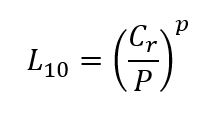
Rule of thumb: If your bearing rotates under a sustained load, use Cr. If your bearing must withstand a sudden impact or hold a static load, check C0r.
Since revolutions are impractical for most engineering applications, we convert to operating hours:
Follow these five steps to calculate bearing life for any deep groove ball bearing application.
Step 1 — Identify the Applied Loads
Determine the actual radial load (Fr) and axial load (Fa) acting on the bearing under operating conditions.
• Fr = Radial load (perpendicular to shaft axis), in Newtons
• Fa = Axial load (parallel to shaft axis), in Newtons
For belt-driven applications, include belt tension. For gear drives, include both tangential and radial gear forces. For fans and motors, often only radial load from rotor weight and belt/coupling forces applies.
Step 2 — Calculate the Equivalent Dynamic Load (P)
For radial bearings (like deep groove ball bearings), the equivalent dynamic load P accounts for both radial and axial loads using the following formula from ISO 281:
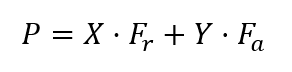
Where X and Y are dimensionless load factors that depend on the ratio Fa/C0r and Fa/Fr. These factors are provided in manufacturer load tables.
Simplified approach for pure radial loads:
If Fa = 0 (no axial load):
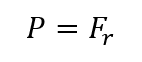
For combined loading: Consult the bearing's X/Y factor table. For most standard 6200/6300-series deep groove ball bearings with moderate axial loads:
If Fa/Fr ≤ e: P = Fr (axial load is negligible)
If Fa/Fr > e: P = 0.56·Fr + Y·Fa
The value of e and Y depend on the Fa/C0r ratio and are specific to each bearing model.
Step 3 — Look Up Cr from the Bearing Datasheet
Obtain the dynamic load rating Cr from your bearing manufacturer's catalog or datasheet. Welink Bearing publishes full load rating data for all standard bearing series (6000, 6200, 6300, 6900, MR series, etc.).
Example Cr values for common Welink deep groove ball bearings:
| Bearing Model |
Bore (d) |
OD (D) |
Width (B) |
Cr (kN) |
C0r (kN) |
| 6000 |
10 mm |
26 mm |
8 mm |
4.55 |
1.96 |
| 6200 |
10 mm |
30 mm |
8 mm |
5.10 |
2.36 |
| 6201 |
12 mm |
32 mm |
10 mm |
6.82 |
3.10 |
| 6202 |
15 mm |
35 mm |
11 mm |
7.65 |
3.72 |
| 6205 |
25 mm |
52 mm |
15 mm |
14.0 |
6.95 |
| 6305 |
25 mm |
62 mm |
17 mm |
22.5 |
11.2 |
| 6206 |
30 mm |
62 mm |
16 mm |
19.5 |
10.0 |
| 6306 |
30 mm |
72 mm |
19 mm |
28.1 |
14.6 |
Values are nominal and may vary by tolerance grade and internal design. Always verify with the Welink Bearing datasheet for your specific model.
Step 4 — Apply the L10h Formula
Now plug your values into the life formula:

Step 5 — Compare Against Your Required Service Life
Most applications have a target service life. Common industry benchmarks:
| Application |
Typical Required L10h |
| Household appliances |
1,000 – 2,000 hours |
| Electric motors (industrial) |
20,000 – 30,000 hours |
| Pumps |
20,000 – 40,000 hours |
| Agricultural machinery |
3,000 – 5,000 hours |
| Machine tools |
20,000 – 50,000 hours |
| Automotive (non-critical) |
1,500 – 5,000 hours |
If your calculated L10h exceeds the required service life, your bearing selection is valid. If not, you need to either:
• Select a bearing with a higher Cr (larger series or larger bore)
• Reduce the applied load P (redesign mounting or transmission)
• Reduce speed n
• Increase the bearing bore and OD
Modified Life Calculation: ISO 281:2007 with aISO Factor
The basic L10 formula assumes standard conditions. In reality, lubrication quality, contamination, and material cleanliness all dramatically affect bearing life. ISO 281:2007 introduced the modified rating life (Lnm) to account for these factors:

Factor Definitions
a₁ — Reliability Factor
| Reliability (%) |
Lnm designation |
a₁ |
| 90 |
L10 |
1.00 |
| 95 |
L5 |
0.64 |
| 99 |
L1 |
0.25 |
| 99.9 |
L0.1 |
0.093 |
For most standard industrial applications, 90% reliability (a₁ = 1.00) is used.
aISO — System Approach Life Modification Factor
aISO accounts for lubrication quality (via the viscosity ratio κ) and contamination level (via the contamination factor eC). It is determined from charts in ISO 281:2007, Annex A.

Where:
• κ = actual viscosity / required viscosity (κ > 1 = well-lubricated; κ < 1 = under-lubricated)
• eC = contamination factor (ranges from 1.0 for clean lab conditions to 0.1 or below for heavy contamination)
• Cu = fatigue load limit of the bearing (available from manufacturer datasheets)
Practical insight from Welink Bearing: In real-world pump and motor applications, κ often falls between 0.8 and 1.2, and eC between 0.5 and 0.8. These factors together mean actual modified life is typically 1.5× to 3× the basic L10 or as low as 0.5× under poor lubrication and heavy contamination. This is why proper sealing (2RS vs. ZZ) and grease selection matter enormously.
Worked Example: Selecting a Bearing for a Fan Motor
Application: Industrial fan motor
Required service life: 25,000 hours
Rotational speed: 1,450 rpm
Radial load (Fr): 1,200 N
Axial load (Fa): 0 N (pure radial application)
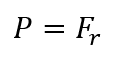
Step 1 — Determine Equivalent Load P
Since Fa = 0:

Step 2 — Determine Required Cr
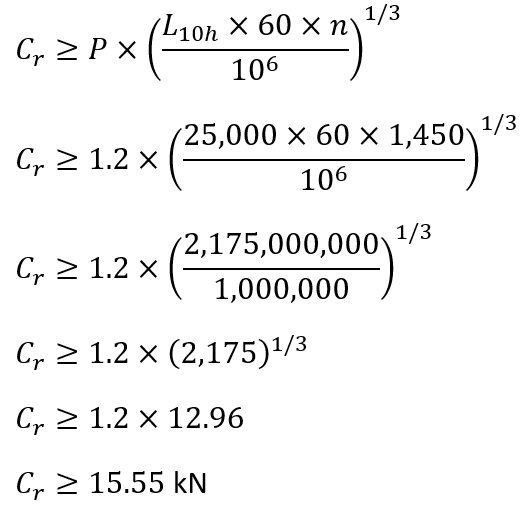
Rearranging the L10h formula to solve for the minimum required Cr:
Step 3 — Select a Bearing
Looking at our catalog, the 6206 (30mm bore, Cr = 19.5 kN) comfortably exceeds the required 15.55 kN minimum. However, if bore size is fixed at 25mm, the 6305 (25mm bore, Cr = 22.5 kN) is a strong candidate from the 6300 heavy series.
Step 4 — Verify with L10h Calculation
Using 6206 (Cr = 19,500 N, P = 1,200 N, n = 1,450 rpm):
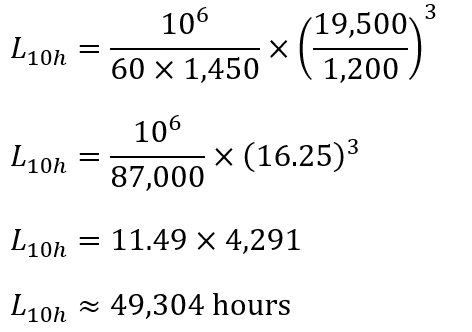
The 6206 provides nearly twice the required service life, excellent for a fan motor application where maintenance access is difficult.
Step 5 — Check Static Safety Factor
At standstill or start-up with full load:
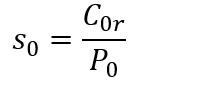
For 6206: C0r = 10,000 N; P0 (static equivalent load) = Fr = 1,200 N
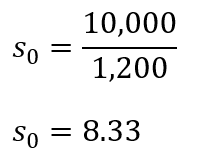
ISO 76 recommends s0 ≥ 1.0 for smooth operation, and ≥ 2.0 for applications with moderate shock. A value of 8.33 is well within safe limits.
Common Mistakes When Using Cr and C0r
Mistake 1: Confusing Cr with maximum allowable load
Cr is not a maximum load limit. It is the load under which L10 = 1 million revolutions. You can exceed Cr, but life will be dramatically shortened.
Mistake 2: Ignoring C0r for applications with shock loads
A pump that hammers at start-up or a conveyor system with sudden load spikes must have C0r checked. Exceeding C0r even briefly causes permanent raceway denting, dramatically accelerating wear even if the dynamic load seems acceptable.
Mistake 3: Forgetting to convert units
Cr values in datasheets may be listed in kN or N. Always ensure Cr and P are in the same unit before calculating the (Cr/P) ratio. This is the single most frequent arithmetic error in field calculations.
Mistake 4: Using catalog Cr without considering operating temperature
At temperatures above 120°C, bearing steel hardness decreases and the effective load rating must be derated using a temperature correction factor (f₁). Standard grease-packed bearings should not be used above 120°C without consulting the manufacturer.
Mistake 5: Assuming L10h is the expected life
L10h means 10% of bearings will fail before that time. For critical applications, always apply the a₁ reliability factor (or use L1 for 99% reliability) and the aISO lubrication factor. Relying on L10h alone in a high-consequence application is engineering negligence.
Mistake 6: Using a light series bearing (6200) where a heavy series (6300) is needed
The 6300 series has the same bore as the 6200 series but a significantly larger outer diameter and higher Cr. When life calculations using a 6200 bearing fall short, switching to the 6300 series of the same bore size is often the simplest solution.
Quick Reference: Load Ratings for Popular Deep Groove Ball Bearing Models
6200 Series
| Model |
d (mm) |
D (mm) |
B (mm) |
Cr (kN) |
C0r (kN) |
Speed (rpm, grease) |
| 6200 |
10 |
30 |
9 |
5.10 |
2.36 |
22,000 |
| 6201 |
12 |
32 |
10 |
6.82 |
3.10 |
19,000 |
| 6202 |
15 |
35 |
11 |
7.65 |
3.72 |
17,000 |
| 6203 |
17 |
40 |
12 |
9.55 |
4.75 |
15,000 |
| 6204 |
20 |
47 |
14 |
12.8 |
6.55 |
13,000 |
| 6205 |
25 |
52 |
15 |
14.0 |
6.95 |
11,000 |
| 6206 |
30 |
62 |
16 |
19.5 |
10.0 |
9,500 |
| 6207 |
35 |
72 |
17 |
25.5 |
13.7 |
8,500 |
| 6208 |
40 |
80 |
18 |
29.5 |
16.0 |
7,500 |
6300 Series
| Model |
d (mm) |
D (mm) |
B (mm) |
Cr (kN) |
C0r (kN) |
Speed (rpm, grease) |
| 6300 |
10 |
35 |
11 |
7.95 |
3.40 |
19,000 |
| 6301 |
12 |
37 |
12 |
9.75 |
4.15 |
17,000 |
| 6302 |
15 |
42 |
13 |
11.5 |
5.20 |
16,000 |
| 6303 |
17 |
47 |
14 |
13.5 |
6.20 |
14,000 |
| 6304 |
20 |
52 |
45 |
15.9 |
7.80 |
12,000 |
| 6305 |
25 |
62 |
17 |
22.5 |
11.2 |
10,000 |
| 6306 |
30 |
72 |
19 |
28.1 |
14.6 |
8,500 |
| 6307 |
35 |
80 |
21 |
33.2 |
18.0 |
7,500 |
| 6308 |
40 |
90 |
23 |
40.5 |
22.4 |
6,700 |
All ratings are nominal reference values. Contact Welink Bearing for certified datasheet values and application-specific recommendations.
Q: Can I use both Cr and C0r in the same calculation?
A: They serve different purposes. Use Cr for the L10h fatigue life calculation (rotating load). Use C0r to check the static safety factor s0 = C0r/P0, particularly for shock-loaded or standstill conditions. Both should be checked for a complete bearing selection.
Q: What happens if the equivalent load P exceeds Cr?
A: Life drops dramatically. At P = Cr, L10 = 1 million revolutions. At P = 2×Cr, L10 = 1/8 million revolutions (125,000). The cubic relationship means even a 25% overload halves bearing life. Always target a comfortable safety margin.
Q: How do I calculate P when there is significant axial load?
A: Use the X/Y factor method from ISO 281. Calculate Fa/C0r to determine the applicable row in the X/Y table, then apply P = X·Fr + Y·Fa. If Fa/Fr ≤ e, axial load is negligible and P = Fr.
Q: Does bearing clearance (C3 vs. CN) affect Cr?
A: The published Cr is for standard internal clearance (CN). C3 clearance bearings do not have a different Cr, but clearance affects load distribution, temperature rise, and noise, all of which influence real-world service life beyond what the formula captures alone.
Q: What is a "basic" versus "modified" rating life?
A: Basic life (L10) assumes standard operating conditions (adequate lubrication, clean environment, normal material). Modified life (Lnm per ISO 281:2007) adjusts for real-world conditions using the aISO factor that accounts for lubrication viscosity, contamination level, and fatigue load limit.
Q: My bearing is failing well before the calculated L10h. Why?
A: The most common causes are: (1) actual load exceeds the calculated P (misalignment, unbalance, or impulse loads), (2) lubricant degradation or insufficient lubrication (low κ), (3) contamination entering the bearing (check sealing integrity), (4) incorrect installation causing preload or misalignment, or (5) the bearing operating at elevated temperature derated below its rated Cr.
Understanding the difference between dynamic load rating (Cr) and static load rating (C0r) is not just academic. It is the foundation of reliable bearing selection. Cr tells you how long a bearing will last under rotating loads; C0r tells you whether it will survive shock, standstill, or momentary overload without permanent damage.
The ISO 281 L10h formula gives you a systematic, reproducible method to predict bearing life in hours. When you combine this with the modified life approach (aISO factor), you can account for real-world conditions and arrive at a selection you can defend with engineering data, not guesswork.
At Welink Bearing, we specialize in deep groove ball bearings for motors, pumps, fans, power tools, robotics, and industrial machinery. Our engineering team provides full load rating datasheets, application consultation, and custom bearing specifications for OEM customers globally.
Need help calculating bearing life for your application? Contact Welink Bearing's technical team, we'll help you match the right bearing model to your load, speed, and service life requirements.
Welink Bearing | Deep Groove Ball Bearing Manufacturer & Exporter
Specializing in 6000, 6200, 6300, 6900 series | MR miniature bearings | Stainless steel & chrome steel options