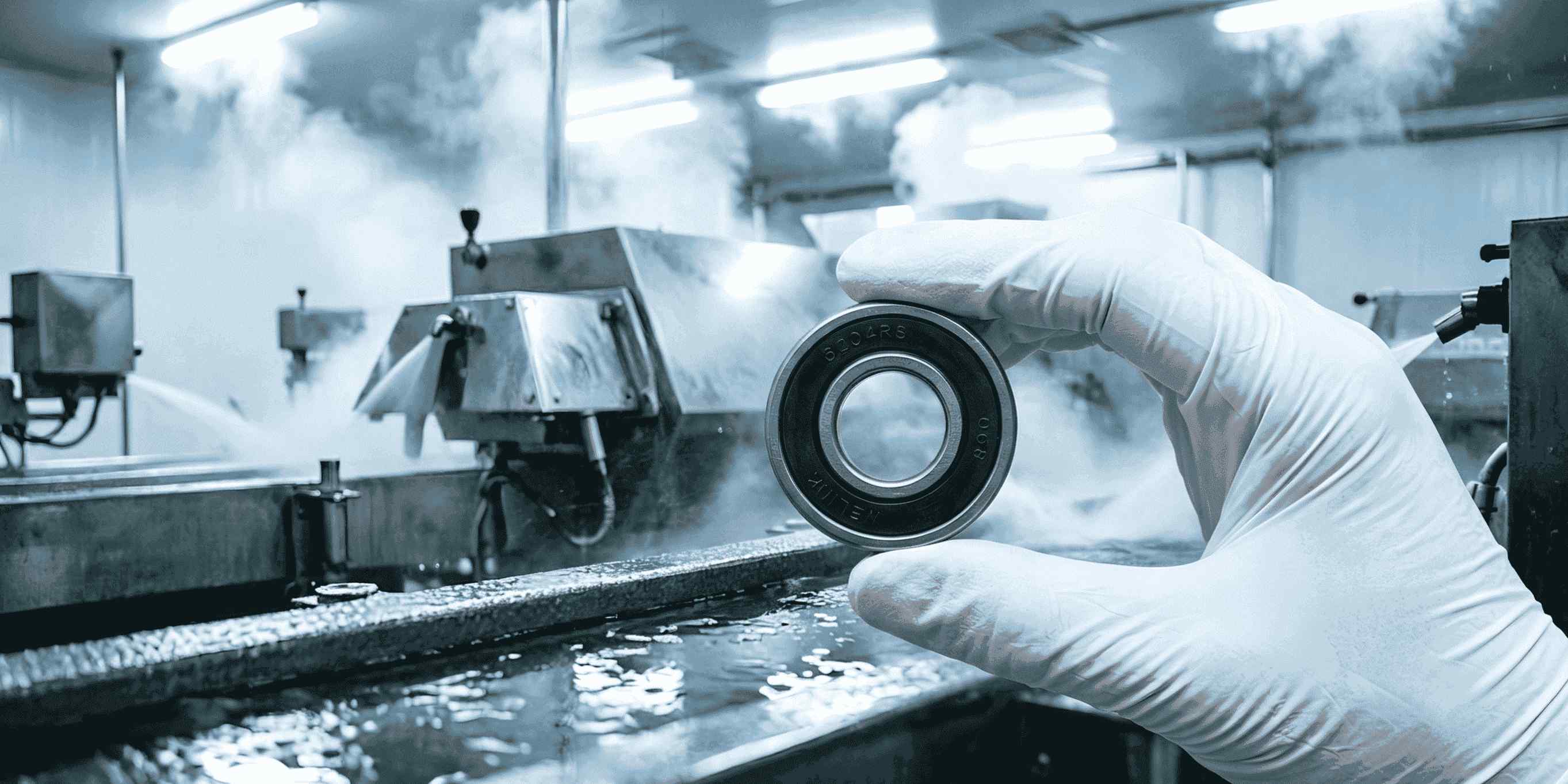
In the food and beverage (F&B) industry, equipment failure is more than a maintenance issue. It is a critical hygiene risk. Machinery operating in meat processing plants, commercial bakeries, and bottling facilities is constantly subjected to high-pressure washdowns, aggressive cleaning chemicals, and strict FDA and local hygiene regulations.
Standard industrial bearings simply will not survive these conditions. To prevent product contamination and costly downtime, manufacturers must specify purpose-built food-grade bearings.
As a specialised manufacturer of deep groove ball bearings, Welink Bearing understands the rigorous engineering behind food safety. In this guide, we break down the exact material, lubrication, and sealing requirements you need to consider when sourcing bearings for F&B applications.
💡 Key Takeaways for Engineers
• Material: Stainless steel (such as AISI 440C / SUS420) is the industry standard for resisting rust and chemical corrosion during washdowns.
• Lubrication: Bearings must utilise NSF H1 registered food-grade grease for incidental food contact safety.
• Sealing: 2RS (Rubber Contact Seals) are crucial to prevent cleaning fluid ingress and grease leakage.
• Compliance: All components must meet regulatory standards to prevent costly product recalls.
① Material Selection: Defeating Corrosion
A common misconception is that applying food-grade grease to a standard chrome steel (GCr15) bearing makes it suitable for food processing. In reality, chrome steel will rapidly rust when exposed to the high humidity and caustic agents typical of F&B environments.
Food-grade bearings require highly resistant materials:
• Martensitic Stainless Steel (SUS420 / AISI 440C): The optimal choice for 90% of F&B applications. It offers a precise balance of high hardness (for load capacity and wear resistance) and excellent corrosion resistance against water and mild chemicals.
• Austenitic Stainless Steel (SUS304 / SUS316): Often used for bearing housings or cages. While providing superior corrosion resistance—ideal for heavy salt or acid exposure in meat or dairy processing—they are softer and generally not used for the rolling elements themselves.
• Ceramic and Hybrid Bearings: For extreme environments with severe chemical exposure or high-speed centrifuges, hybrid bearings (stainless steel rings with silicon nitride ceramic balls) are deployed. Ceramic is immune to rust and requires minimal lubrication.
② The Make-or-Break Factor: Food-Grade Lubrication
Even the most robust stainless steel bearing will fail prematurely if improperly lubricated. Furthermore, if standard industrial grease contaminates a food batch, the resulting recalls can be devastating.
Lubricants are strictly categorised, with NSF H1 (Incidental Food Contact) being the gold standard. H1 greases are odourless, tasteless, and chemically inert.
Pro Tip from Welink Engineers: Always specify a high-washdown, water-resistant NSF H1 grease. Standard H1 grease can wash out under high-pressure cleaning if it lacks water-resistant thickeners, such as an aluminium complex or calcium sulfonate.
③ Sealing Solutions: Retaining Grease and Blocking Contaminants
F&B facilities undergo rigorous Clean-In-Place (CIP) protocols, blasting equipment with hot water, steam, and antibacterial foams. Open bearings or those with metal shields (ZZ) are insufficient; water will easily penetrate the gap, washing away the grease and causing immediate catastrophic failure.
• Rubber Contact Seals (2RS): Nitrile Rubber (NBR) or Viton (FKM) seals are heavily recommended. They make physical contact with the inner ring, creating a tight barrier that keeps cleaning fluids out and food-grade grease in.
• Food-Safe Cages: Cages should be moulded polyamide (nylon) or stainless steel, ensuring they do not shed particles and can withstand thermal shock during cleaning.
Standard vs. Food-Grade Bearings: A Quick Comparison
| Feature |
Standard Industrial Bearings |
Food-Grade Bearings |
| Primary Material |
Chrome Steel (GCr15) |
Stainless Steel (SUS420, SUS304, SUS316) |
| Lubrication |
Industrial Lithium Grease |
NSF H1 Registered Food-Grade Grease |
| Operating Environment |
Dry, general industrial |
High humidity, caustic washdown, corrosive |
| Sealing |
Open or ZZ (Metal Shields) |
2RS (Rubber Contact Seals) |
| Regulatory Compliance |
ISO, ABMA |
FDA, NSF, EHEDG compliant |
Why Choose Welink Bearing for Your Food Machinery?
Since 2010, Welink Bearing has been a specialised manufacturer integrating R&D and production. We provide high-precision deep groove ball bearings tailored to the exact needs of global food machinery manufacturers.
Our advantages include:
• Precision Manufacturing: ISO 9001 certified production with precision grades from P0 to P5, guaranteeing smooth, quiet operation.
• Customisation (OEM/ODM): We can tailor bearing dimensions, specialised sealing structures, and factory-fill NSF H1 lubrication to match your specific machinery requirements.
• Integrated Production: Maintaining strict control over our manufacturing bases allows us to deliver top-tier craftsmanship at highly competitive price points.
Don't let substandard components jeopardise your production line. Contact our engineering team today to discuss reliable, hygienic bearing solutions.
Frequently Asked Questions (FAQ)
Q: Can I use Chrome Steel bearings if I use food-grade grease?
A: It is highly discouraged for washdown environments. Even with food-grade grease, the external surfaces of a chrome steel bearing will oxidise rapidly when exposed to water, leading to severe hygiene issues.
Q: How long do food-grade bearings last?
A: Lifespan depends heavily on sealing and maintenance. Using high-quality 2RS seals and proper washdown-resistant H1 grease will significantly extend bearing life by preventing fluid ingress.
Q: Are ZZ (Metal Shield) bearings suitable for food processing?
A: Generally, no. Metal shields leave a micro-gap and do not provide a watertight seal. They are insufficient for environments subjected to liquid splashes or CIP washdowns.