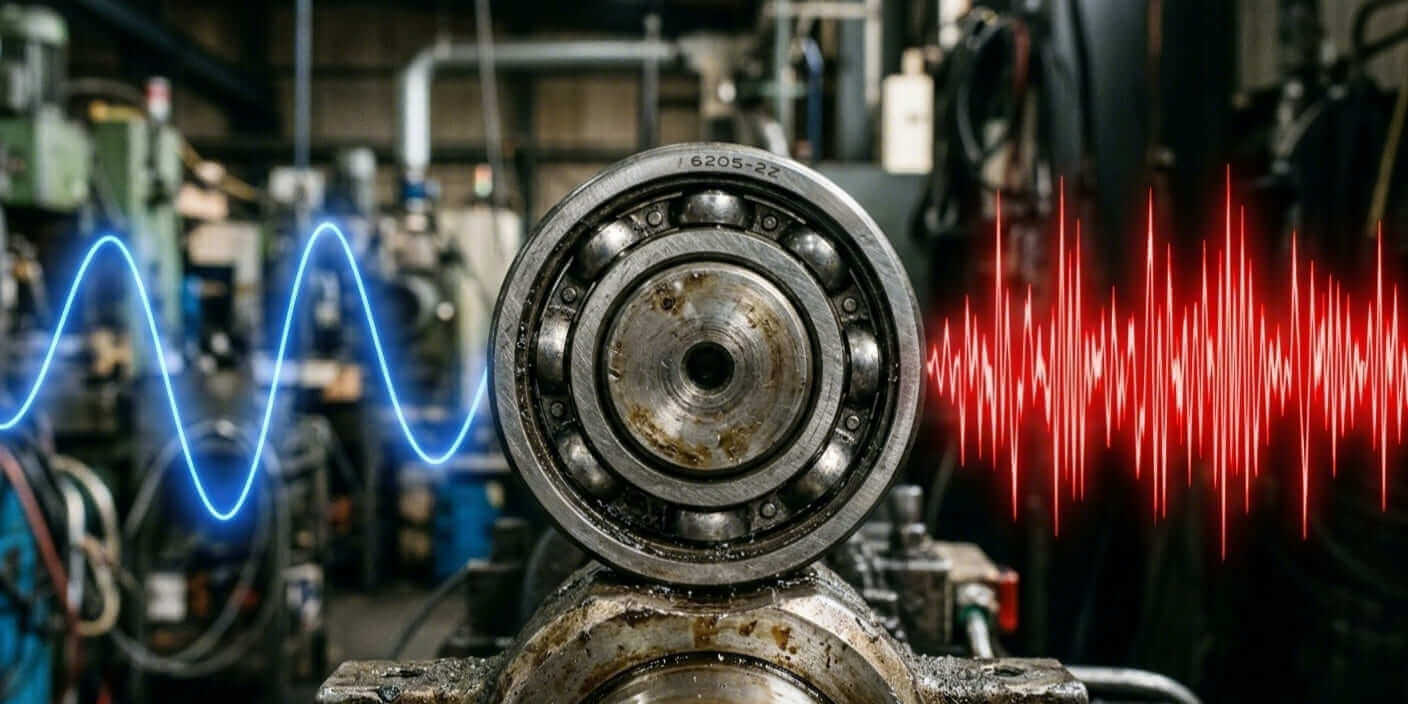
If you are manufacturing high-precision electric motors, you already know that bearing vibration is the enemy. It generates unwanted noise, increases operating temperatures, and ultimately shortens the lifespan of your product.
When your Quality Assurance team places a deep groove ball bearing on a vibration tester (such as a BVT instrument), they are typically presented with two primary metrics: Velocity (V) and Acceleration (Z).
But what exactly is the difference? And more importantly, if you are designing a high-speed, low-noise motor for drones, medical devices, or premium home appliances, which metric should you rely on?
As a manufacturer heavily invested in the R&D of ultra-quiet deep groove ball bearings, Welink Bearing has helped countless motor engineers optimize their testing protocols. In this guide, we will break down the science of bearing vibration analysis and help you choose the right measurement for your application.
The Basics: Why Measure Bearing Vibration?
Vibration in a deep groove ball bearing is rarely caused by a single factor. It is the cumulative result of microscopic geometric imperfections (like raceway waviness), contamination, improper lubrication, or slight ball size variations.
By analyzing the vibration signature, engineers can effectively "look inside" the bearing without dismantling it. However, because different defects generate vibrations at different frequencies, we need different metrics to capture them accurately.
What is Velocity (V) in Bearing Analysis?
Velocity measures the speed at which the bearing's components vibrate back and forth. It is typically measured in millimeters per second (mm/s) or inches per second (in/s).
• The Frequency Focus: Velocity is most effective at detecting low to medium frequency vibrations (usually between 10 Hz and 1,000 Hz).
• What It Detects: Velocity is the best indicator of overall fatigue energy. It highlights macroscopic mechanical issues such as unbalance, misalignment, structural looseness, or severe wear.
• Industry Standard: In bearing classifications, this is represented by the V-Group (e.g., V1, V2, V3, V4), where a higher number indicates stricter vibration limits and smoother operation.
What is Acceleration (Z) in Bearing Analysis?
Acceleration measures the rate of change in velocity. It is typically measured in meters per second squared (m/s²) or G-force ('g').
• The Frequency Focus: Acceleration dominates in the high-frequency range (typically 1,000 Hz to 10,000 Hz and beyond).
• What It Detects: Acceleration is incredibly sensitive to microscopic, sudden impacts. It detects early-stage raceway defects (like tiny scratches or spalling), lubrication starvation, and minute ball imperfections.
• Industry Standard: This is represented by the Z-Group (e.g., Z1, Z2, Z3, Z4). Bearings with a Z3 or Z4 rating are considered premium low-noise bearings.
Velocity vs. Acceleration: The Quick Comparison
To help you decide which parameter matters most for your motor application, here is a quick reference breakdown:
| Feature |
Velocity (V) |
Acceleration (Z) |
| Measurement Unit |
mm/s or in/s |
m/s² or 'g' |
| Frequency Range |
Low to Medium (10 Hz – 1,000 Hz) |
High (1,000 Hz – 10,000+ Hz) |
| Primary Indication |
Overall machine health, fatigue energy |
Micro-defects, high-frequency noise |
| Common Defects Found |
Misalignment, unbalance, looseness |
Insufficient lubrication, raceway scratches, ball defects |
| Human Perception |
Felt as physical shaking/trembling |
Heard as high-pitched "whining" or acoustic noise |
Which Metric Should High-Precision Motor Manufacturers Choose?
The short answer: If acoustic noise is your primary concern, you must focus on Acceleration (Z).
① Standard Industrial Motors (Pumps, Conveyors)
For general-purpose industrial motors where slight mechanical noise is acceptable, Velocity (V) is often sufficient. It ensures the bearing won't cause the entire machine to shake itself apart due to unbalance.
② High-Precision & Consumer Motors (Drones, Massage Chairs, HVAC)
If you are designing a motor for a premium massage chair, an indoor air purifier, or a UAV drone, human hearing is the ultimate judge.
Humans are highly sensitive to high-frequency sounds (the annoying "whine" or "buzz"). Because Acceleration (Z) spikes when tiny surface imperfections create high-frequency impacts, measuring Z is the only way to guarantee a truly quiet motor.
(Learn more about our quiet motor applications in our previous post: How a Massage Chair Manufacturer Reduced Motor Noise with Better Bearing Selection).
The Welink Bearing Advantage: Engineering the Ultimate Z4 Bearing
Achieving a high-grade Z3 or Z4 acceleration rating requires exceptional manufacturing precision. You cannot simply grease a standard bearing and expect the acceleration values to drop.
At Welink Bearing, our integrated manufacturing and trading model allows us to control the noise at the source through our dedicated R&D center:
• Advanced Superfinishing: Our raceways undergo rigorous multi-step superfinishing (honing) to eliminate the microscopic waviness that triggers high acceleration spikes.
• Precision Steel Balls: We utilize high-grade steel balls with strict roundness tolerances to prevent high-frequency chatter.
• 100% BVT Testing: Every batch of our low-noise deep groove ball bearings is tested on state-of-the-art vibration testers, ensuring they meet strict V and Z parameters before shipping globally.
Whether you need a bearing that withstands heavy radial loads or runs silently at 20,000 RPM, Welink Bearing provides the data-backed solutions your engineering team needs.
Frequently Asked Questions (FAQ)
Q: Can I convert a Velocity measurement to an Acceleration measurement?
A: No, not directly. While they are mathematically related (acceleration is the derivative of velocity), bearing vibration testers apply different frequency band filters to each. A bearing might pass a Velocity (V) test perfectly but fail an Acceleration (Z) test due to microscopic raceway scratches.
Q: What does a "Z3V3" suffix mean on a deep groove ball bearing?
A: A Z3V3 designation means the bearing has passed rigorous testing for both high-frequency impacts (Z3 class) and overall vibrational speed (V3 class). It is an excellent choice for low-noise electric motors.
Q: Why is my bearing vibrating heavily despite having a Z3 rating?
A: If a high-precision Z3 bearing is vibrating in your motor, the issue is likely due to improper installation (which can dent the raceways), poor shaft/housing tolerances, or selecting the wrong internal clearance (e.g., using a C3 clearance when a CN is required).
Need help selecting the perfect low-noise deep groove ball bearing for your next motor project? Contact the Welink Bearing engineering team today for a customized consultation and free samples.