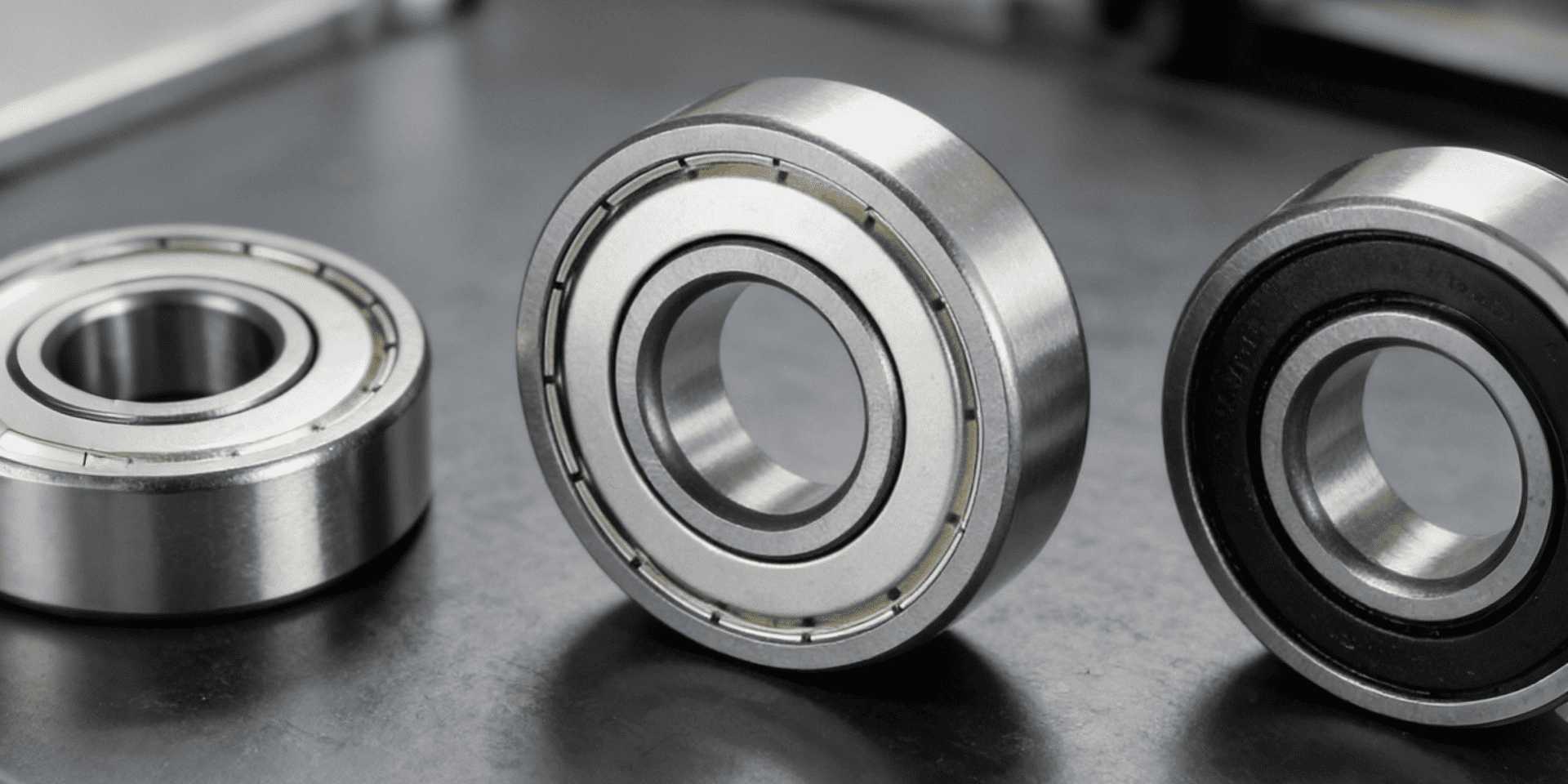
If you are designing a micro motor, you already know that space is your biggest constraint. When you scale down to the 2x5mm footprint of an MR52 miniature deep groove ball bearing, the margin for error practically disappears.
At Welink Bearing, one of the most common debates we see among mechanical engineers and motor designers isn't about the dimensions, it's about the shielding. Should you specify the metal-shielded MR52ZZ or the rubber-sealed MR52-2RS?
Making the wrong choice here doesn't just affect the bearing's lifespan; in a micro motor, it can drain battery life, cause overheating, or lead to catastrophic failure under load. Let’s break down the engineering reality behind these two options.

The Baseline: MR52 Bearing Dimensions
Before diving into the shields, let's clarify the dimensions. While an "open" MR52 is 2mm wide, the shielded and sealed versions typically add a fraction of a millimeter to accommodate the covers.
• Inner Diameter (d): 2mm
• Outer Diameter (D): 5mm
• Width (B): 2.5mm (for both ZZ and 2RS variants)
MR52ZZ (Metal Shields): The High-Speed Champion
The "ZZ" designation indicates that the bearing has non-contact metal shields on both sides. These shields are pressed into the outer ring and do not touch the inner ring.
The Engineering Advantage:
Because there is zero physical contact between the shield and the moving inner ring, friction is kept to an absolute minimum. This is critical for micro motors.
• Speed: MR52ZZ can comfortably handle ultra-high speeds, often exceeding 80,000 RPM depending on the lubrication.
• Heat Dissipation: Less friction means less thermal expansion, keeping your motor's internal temperatures stable.
The Trade-off:
Metal shields have a micro-gap. While they easily deflect larger particles and prevent the grease from flying out, they cannot stop microscopic dust, vapor, or moisture.
MR52-2RS (Rubber Seals): The Protection Specialist
The "2RS" stands for two rubber seals. These are typically made of NBR (Nitrile rubber) bonded to a steel insert, and their inner lip makes physical contact with the inner ring of the bearing.
The Engineering Advantage:
The contact lip creates a physical barrier. If your micro motor is operating in a harsh environment, like an outdoor RC servo, a dental tool exposed to aerosols, or a drone flying through dusty environments, the 2RS seal keeps contamination out and locks the lubricant in.
The Trade-off (The "Micro Motor Penalty"):
Here is where many designers stumble. In larger bearings, seal drag is negligible. But in a tiny MR52 bearing, the starting torque required to overcome the rubber lip's friction is proportionally massive. It can drain micro-batteries faster and generate significant heat, usually limiting the safe operating speed to around 30,000 to 40,000 RPM.
Quick Comparison Guide
To help you decide, here is a quick reference table based on our testing data at Welink Bearing:
The Hidden Variable: Internal Clearance and Lubrication
Choosing between ZZ and 2RS is only half the battle. As a manufacturer focused on deep groove ball bearings, we always remind our clients to consider internal clearance (e.g., C0 vs. C3) and grease fill rate.
If you choose an MR52ZZ for a high-speed 60,000 RPM motor, packing it with 50% grease will cause "churning," leading to overheating and leakage regardless of the metal shields. For high speeds, a 25% to 30% fill rate of low-viscosity synthetic grease is optimal. If you are using an MR52-2RS for a low-speed, high-torque robotic joint, a higher fill rate with a heavier grease will maximize lifespan.
Conclusion
There is no "better" bearing, only the right bearing for your specific application.
• Choose the MR52ZZ if your priority is high RPM, low power consumption, and low starting torque in a relatively clean environment.
• Choose the MR52-2RS if your motor operates at lower speeds but needs serious protection against dust, dirt, or moisture.