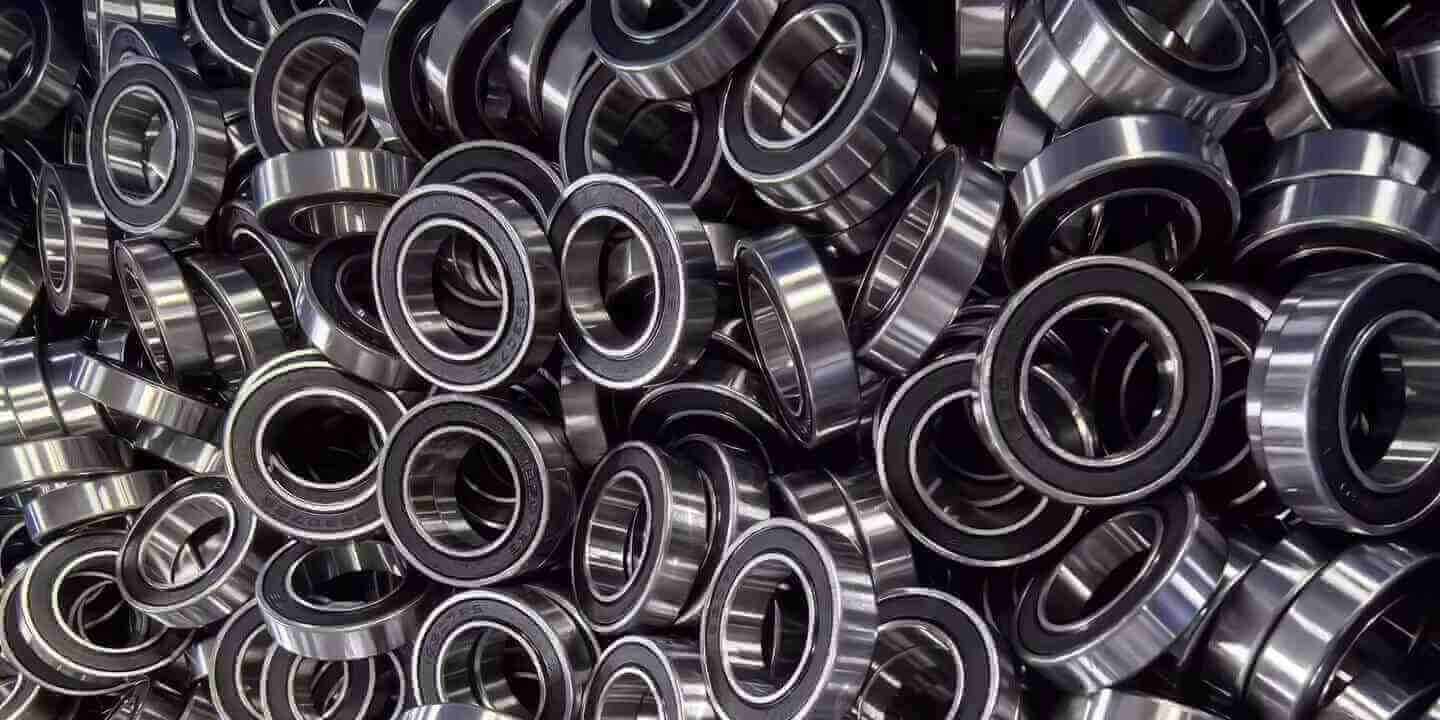
Deep groove ball bearings are one of the most widely used bearing types in the world. From electric motors to automotive wheels, they enable smooth rotation under various loads and speeds. But how exactly is a deep groove ball bearing made?
While it looks simple, consisting of just a few rings, balls, and a cage, the manufacturing process requires micron-level precision and strict quality control. One wrong move, and the bearing fails. Below, we detail the complete 13-step production process.
(Note: If you are looking for a reliable bearing partner, we warmly welcome you to visit the Welink Bearing factories in Ningde or Ningbo to see this process in action!)
Part 1: Ring Manufacturing
Step 1: Raw Material Preparation
• The production process begins with high-quality bearing steel.
• Typically, GCr15 (or its equivalent, AISI 52100) is used.
• Steel bars or tubes are cut into blanks, providing the foundational material for the inner rings, outer rings, and wire rods for the balls.
Step 2: Forging
• The steel blanks are heated and forged into rough ring shapes.
• This step improves the grain structure and density of the steel, ensuring ultimate strength and durability.
• After forging, the rings are quickly cooled (normalized) to relieve internal stresses.
Step 3: Turning (Lathing)
• The forged rings go through CNC turning machines to create the basic geometry.
• This establishes the outer diameter, inner diameter, width, and raceway grooves.
• Turning effectively removes excess material and brings the rings close to their final dimensions.
Step 4: Heat Treatment
• This process includes Austenitizing (heating to a high temperature), Quenching (rapid cooling in oil to harden the steel), and Tempering (reheating to a lower temperature to reduce brittleness).
• Heat treatment gives the rings high hardness (typically 60–64 HRC) and excellent wear resistance.
Step 5: Grinding
• Multiple grinding stages bring the rings to their final precision, accurate to the micrometer (0.001mm).
• Face grinding ensures parallel sides.
• OD/ID grinding achieves the exact outer and inner diameters.
• Raceway grinding creates the smooth groove where the balls will eventually run.
Step 6: Superfinishing
• A soft stone oscillates against the rotating raceway to remove microscopic peaks.
• The result is a mirror-like surface with incredibly low roughness (Ra ≤ 0.05μm), which reduces friction, noise, and heat generation.
Part 2: Components & Assembly
Step 7: Ball Manufacturing (Separate Process)
• Balls undergo cold heading, where wire rods are cut and formed into rough spheres.
• Flashing removes the ring around the ball.
• The balls undergo the same heat treatment as the rings.
• They are subjected to rough and fine grinding.
• Finally, lapping provides a final polish to achieve grade 5, 10, or 25 precision (the smaller the grade, the more accurate the ball).
Step 8: Cage Manufacturing
• The cage (retainer) holds the balls evenly apart and dictates the bearing's speed, temperature, and noise characteristics.
• Cages can be stamped from steel metal sheets.
• They can also be injection-molded from nylon/plastic.
• For high-end bearings, brass cages are machined.
Step 9: Assembly
• The inner and outer rings are thoroughly cleaned and inspected.
• Balls are loaded between the rings using an assembly jig or an offset method.
• The cage is then inserted and riveted or snapped into place.
Part 3: Lubrication, Sealing, and Quality Control
Step 10: Greasing (For Sealed Bearings)
• Grease is added in a highly controlled amount, measured in grams or cubic centimeters.
• Too little grease causes wear, while too much increases drag and heat.
• The specific grease type depends on the application, such as high-temperature, low-noise, or food-grade formulations.
Step 11: Seal / Shield Installation
• Rubber seals (2RS) or metal shields (ZZ) are pressed into the outer ring.
• Seals keep contaminants out and retain grease, while shields allow for higher speeds but offer slightly less environmental protection.
Step 12: Final Inspection and Testing
• Bearings are tested for noise and vibration using accelerometers like the Anderon meter or S0910.
• They are checked for running torque (rotational resistance) and radial play (internal clearance).
• Dimensions such as bore, OD, width, and roundness are strictly verified.
• Rejected bearings are discarded, while approved ones are cleaned and coated with anti-rust oil.
Step 13: Packaging
• Bearings are carefully packed into plastic tubes and then into boxes.
• Labels display crucial information, including the model number (e.g., 6204, 6002), brand, ABEC / ISO precision class, and country of origin.
The Welink Bearing Commitment to Quality
Behind the perceived simplicity of a deep groove ball bearing are dozens of complex processes. At Welink Bearing, we maintain extremely strict quality control throughout the entire production cycle, knowing that each step directly impacts the final bearing's performance, lifespan, and reliability.
Advanced automated equipment, precise measuring tools, and highly skilled operators are key to ensuring our production quality. Our core philosophy is simple: Good quality comes from the manufacturing habit, not from inspection.