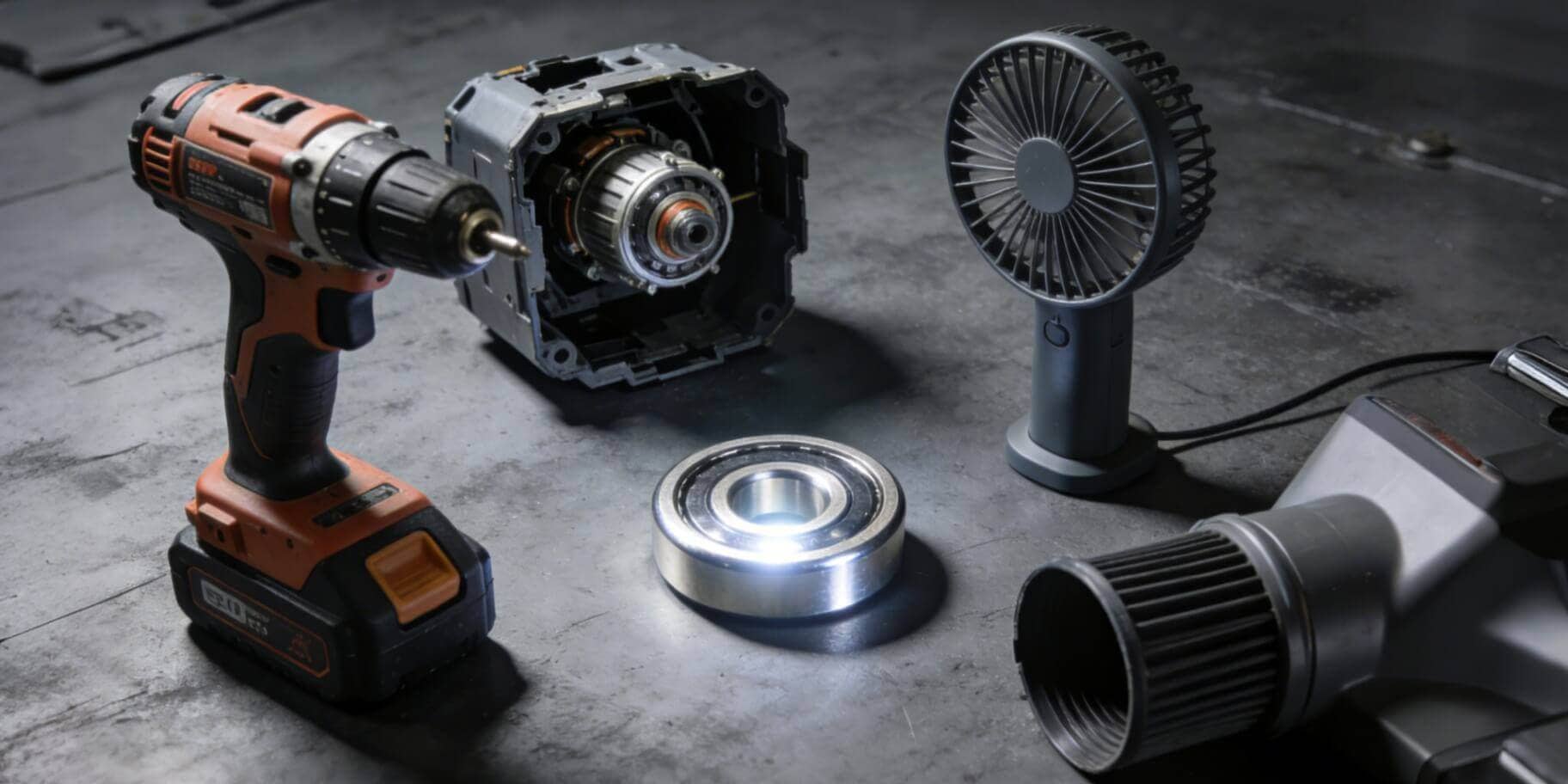
If you work with small motors, whether for power tools, household appliances, or medical devices, you’ve probably faced this headache: the motor runs fine for a while, then starts making noise, vibrating, or just stops. Most of the time, the bearing is the first to give up.
But here’s the good news: with a few practical steps, you can significantly extend bearing life in small motors. And we’ve learned these lessons the hard way, through years of making deep groove ball bearings at Welink Bearing. And we are going to share what actually works.
❶ Start with the right fit.
Small motors have tight internal clearances. If the bearing is too loose, it vibrates. Too tight, it overheats. For most small motors (like those in fans, pumps, or handheld tools), we recommend CN (normal) or C3 clearance, depending on your operating temperature and shaft fit. Not sure which one? Just tell us your motor’s RPM, temperature range, and housing material, we can help you choose. At Welink Bearing, we produce bearings with tolerances from P0 to P5, and we can adjust internal clearance to match your exact assembly conditions. That’s one of the easiest ways to avoid premature failure.
❷ Don’t underestimate lubrication.
Grease is the lifeblood of a bearing. In small motors, too much grease causes churning and heat; too little leads to metal-on-metal wear. We use fully automatic greasing and capping machines in our dust-free workshops to ensure every 6201, 6002, or 608 bearing gets exactly the right amount of high-quality grease. And if your motor runs in extreme temperatures or humidity, we can recommend a different grease type. A well-lubricated bearing can outlast a poorly lubricated one by 3 to 5 times, that’s not marketing, that’s real-world data.
❸ Keep contaminants out.
Small motors often operate in dusty or humid environments, think vacuum cleaners, garden tools, or kitchen appliances. Once dust or moisture enters the bearing, noise and vibration follow quickly. That’s why we pay special attention to seals and shields. We offer ZZ, 2RS, and other sealing options depending on your needs. For most small motors, a non-contact shield (ZZ) keeps dust out without adding friction. For wet conditions, a rubber seal (2RS) is a safer bet. We test every batch with off line real time dimensional inspection and metallurgical microscopes to make sure seals are properly fitted, no shortcuts.
❹ Pay attention to installation.
Even the best bearing will fail early if it’s installed poorly. Common mistakes: pressing on the wrong ring, using too much force, or misaligning the shaft. We’ve seen customers reuse the same old installation tools for years, and then wonder why bearings fail within weeks. A simple press-fit tool and a clean workbench make a huge difference.
If you need advice on mounting or dismounting, just ask. We’ve helped hundreds of motor manufacturers set up better assembly practices.
❺ Choose a supplier who actually tests.
You can’t improve what you don’t measure. At Welink Bearing, we run 100% in-line clearance inspection, fully-automatic noise testing, and use roundness testers and hardness testers on random samples. We also hold ISO, ROHS, and REACH certifications. Every bearing we ship has been checked for noise, vibration, and dimensional accuracy. You won’t get nasty surprises on your production line. We’ve been manufacturing deep groove ball bearings since 2010, with three factories and over 100 experienced staff. We’re not the biggest bearing company in the world, but we are one of the most attentive.
Whether you’re building 5000 motors or 500000, we’d love to help you improve bearing lifetime. Send us a message at sales@welinkbearing.com with your motor specs, and we’ll get back to you with practical suggestions.