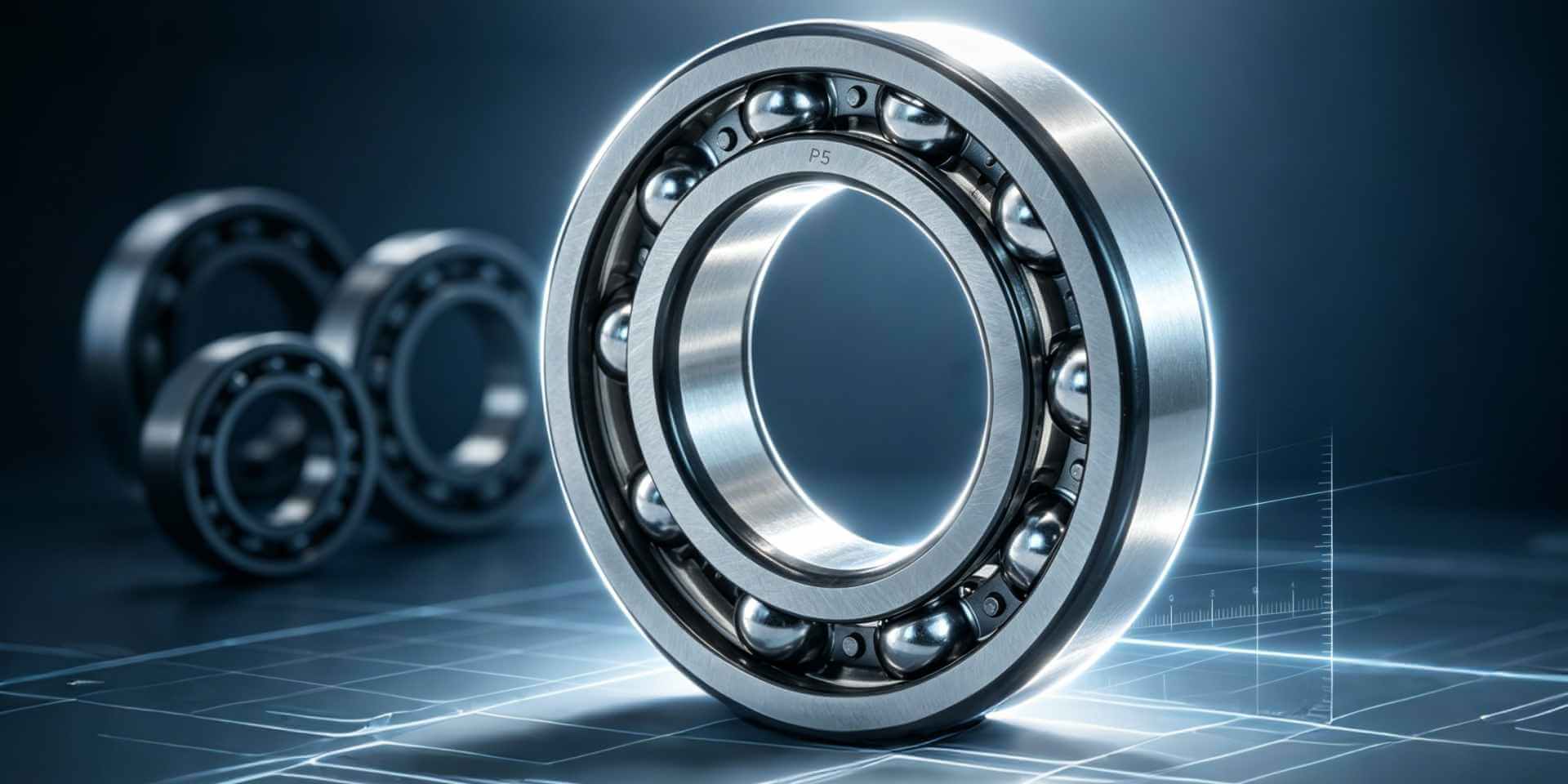
In critical machinery, such as electric motors, CNC machine tools, automation equipment, and new energy vehicles, bearings act as the essential "joints" that keep systems running smoothly. However, when selecting bearings, many engineers and procurement managers find themselves confused by the alphanumeric tolerance classes: P0, P6, P5, P4, and P2.
What do these grades actually mean? Do you immediately need a high-precision bearing just because your operating speed is slightly higher? Is installing a P4 bearing in standard equipment a waste of your budget?
As a specialized manufacturer of deep groove ball bearings, Welink Bearing frequently helps clients navigate these technical specifications. In this comprehensive guide, we will break down the ISO 492 precision grades so you can make accurate, cost-effective decisions for your next project.

What Do Precision Grades Actually Control?
The P0~P5 designations represent precision grades defined by international standards (ISO 492) and Chinese national standards (GB/T 307).
The golden rule: The smaller the number, the higher the precision (P0 is the lowest; P2 is the highest).
These grades primarily govern two technical parameters:
➊ Dimensional Accuracy: How exact the inner diameter (ID), outer diameter (OD), and width tolerances are.
➋ Running Accuracy: The strictness of radial and axial runout during rotation.
Together, these parameters directly dictate your equipment's operational stability, vibration levels, noise generation, service life, and machining accuracy.
Decoding Bearing Precision Grades (From Standard to Ultra-High)
① P0 Grade (Normal Class)
► Meaning: The baseline precision with the widest tolerance range. It is the most commonly used grade and is usually omitted from the bearing part number (e.g., a standard Welink 6205 bearing implies P0).
► Core Parameters (Ref): Radial runout ≤ 8~15 μm, dimensional error approx. ±10 μm.
► Characteristics: Highly cost-effective, mass-produced, with slightly higher acceptable limits for noise and vibration.
► Typical Applications: Standard electric motors, water pumps, industrial fans, household appliances, agricultural machinery, and general gearboxes.
② P6 Grade (Medium/High Class)
► Meaning: A step up from P0, offering tighter dimensional and running tolerances.
► Core Parameters (Ref): Radial runout ≤ 5~10 μm.
► Characteristics: Smoother rotation, suitable for applications requiring moderate precision and positioning.
► Typical Applications: Standard machine tool feed shafts, automotive transmissions, precision motors, reducers, and power tools.
③ P5 Grade (Precision Class)
► Meaning: High-precision grade engineered for minimal vibration and low noise at higher speeds.
► Core Parameters (Ref): Radial runout ≤ 3~6 μm.Characteristics: Demands strict machining of the housing/shaft, precise assembly, and high-quality lubrication.
► Typical Applications: CNC machine tool spindles, precision instruments, high-speed motors, printing presses, and industrial robot joints.
④ P4 Grade (Super Precision Class)
► Meaning: Extremely high precision with stringent tolerance controls.
► Core Parameters (Ref): Radial runout ≤ 1.5~3 μm.
► Typical Applications: High-speed motorized spindles, precision grinders, aerospace engines, and high-accuracy measuring equipment.
⑤ P2 Grade (Ultra-High Precision Class)
► Meaning: The pinnacle of bearing manufacturing, representing ultimate precision.
► Core Parameters (Ref): Radial runout ≤ 1 μm (errors controlled at the nanometer level).
► Typical Applications: Jig boring machines, high-end lithography machines (semiconductor), astronomical telescopes, and aerospace gyroscopes.
Practical Selection: How to Choose the Right Grade?
When selecting deep groove ball bearings, you must balance four critical factors: equipment precision requirements, operational speed, load, and budget.
① Match the Equipment's Precision Needs
• General Equipment (Low requirement): Stick to P0. For the vast majority of general machinery, P0 provides the perfect balance of performance and ROI.
• Medium Precision (Positioning/Smoothness needed): Upgrade to P6. Ideal for standard machine tools and medium-sized motors.
• Precision Equipment (High speed/Accuracy): Specify P5 or above. Mandatory for CNC spindles and high-frequency motors.
• Ultra-Precision Equipment: Requires P4 or P2 (e.g., semiconductor manufacturing).
② Calculate the Speed (dn Value)
The dn value is a key indicator: dn = Bearing Inner Diameter (mm) × Speed (rpm)
• Low Speed (dn < 300,000): P0 / P6
• Medium-High Speed (300,000 < dn < 800,000): P6 / P5
• High/Ultra-High Speed (dn > 800,000): P4 / P23
③ Budget and Cost-Effectiveness
• Mass Production & Cost-Sensitive: Prioritize P0, followed by P6.
• High-End Performance: Invest in P5 or P4. Do not downgrade precision just to save initial costs, as premature failure will cost more in downtime.
④ Crucial Engineering Reminders
• High Precision Bearings ≠ High Precision Equipment: A premium P5 bearing will fail to deliver its benefits if installed on a poorly machined shaft or housing. Proper preloading, clean assembly, and correct lubrication are just as important as the bearing itself.
• Avoid Over-Specifying: If a standard P0 bearing handles the load and speed, do not blindly specify P5. Not only does it increase procurement costs, but higher precision bearings are also more sensitive to contamination and improper installation.
Quick Reference Guide: Bearing Precision at a Glance
| Precision Grade |
Ideal Scenario |
Typical Equipment |
| P0 (Normal) |
General rotation, high cost-efficiency |
Standard motors, pumps, fans, home appliances |
| P6 (Medium) |
Moderate precision, medium speeds |
Auto transmissions, standard machine tools |
| P5 (Precision) |
High accuracy, high speed, low noise |
CNC spindles, precision instruments, robotics |
| P4 / P2 (Ultra) |
Ultra-high speed, extreme accuracy |
Aerospace, measurement devices, lithography |
Summary: Trust the Experts for Your Bearing Needs
To summarize: P0 is the industry workhorse, capable of handling most standard applications. If your design demands higher speeds, quieter operation, and tight positioning, upgrade to P5.
Remember, selecting a bearing isn't about buying the most expensive option, it's about matching the exact tolerance to your specific working conditions.
With over 15 years of deep industry expertise, Welink Bearing is an integrated manufacturer and trader specializing in premium deep groove ball bearings. Whether you need reliable P0 grade 6208 bearings for industrial motors, or high-precision 6015 and 6021 series for demanding technical applications, our engineering team ensures rigorous quality control at every stage of production.
Looking for the right bearing for your next project? Contact Welink Bearing today to discuss your technical specifications with our experts.