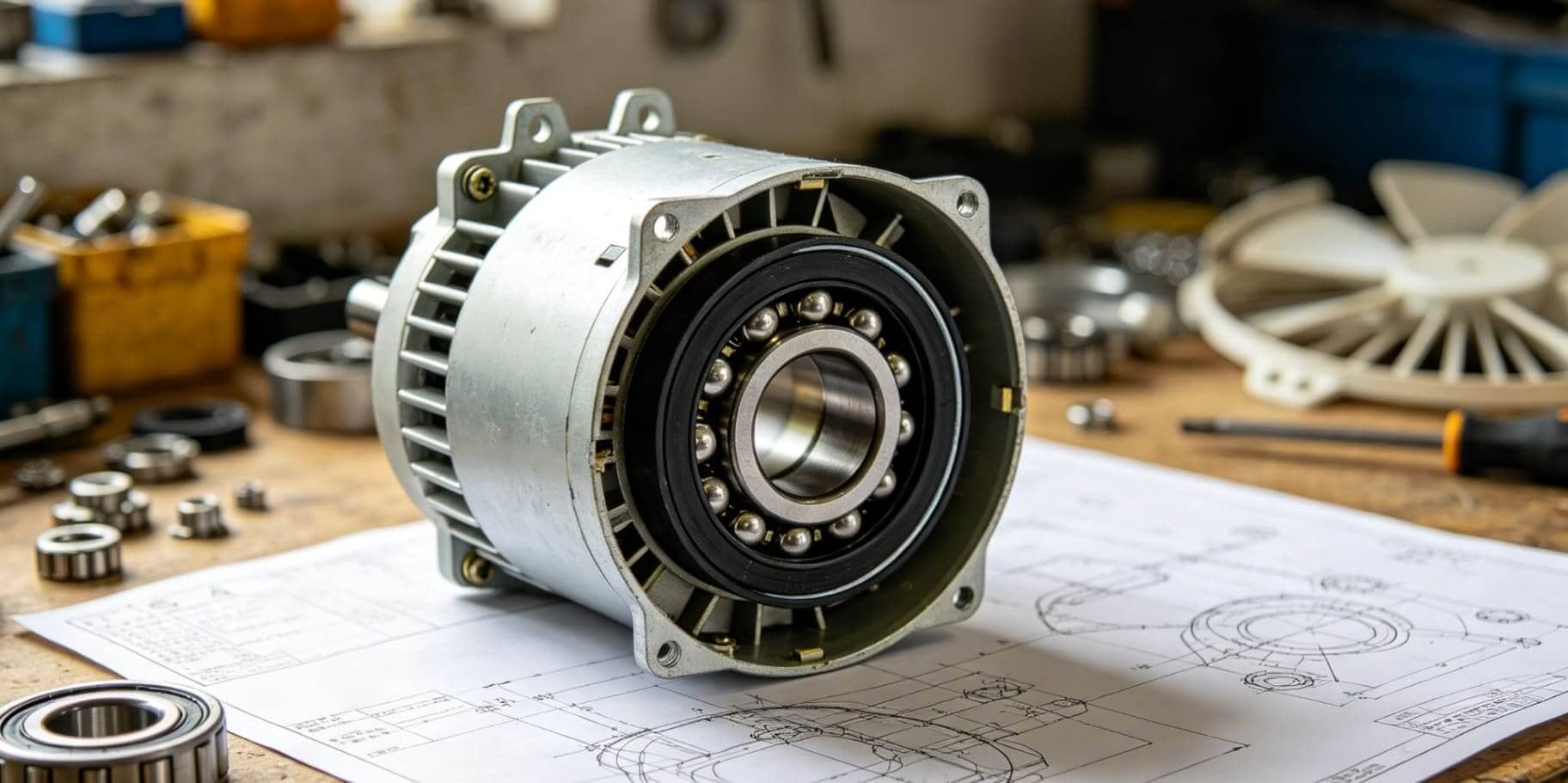
Choosing the right deep groove ball bearing for a fan motor directly affects operational stability, noise level, and service life. Below is a selection guide covering key factors and step-by-step procedures.
➊ Operating features of Fan Motors
Before selecting a bearing, it's important to understand the operating conditions of fan motors:
| Features |
Description |
| High speed |
Fans typically run at medium to high speeds |
| Light load |
Primarily radial load, with minimal axial load |
| Strict noise requirements |
Household/office fans are sensitive to noise |
| Continuous operation |
Most fans need to run for long periods |
| Diverse environments |
May face dust, moisture, or high-temperature conditions |
The typical operating condition of a fan motor is: high speed, light load, low noise requirement, which aligns perfectly with the characteristics of deep groove ball bearings.
➋ Why Deep Groove Ball Bearings Are the First Choice for Fan Motors
Deep groove ball bearings are the most commonly used bearing type for fan motors for the following reasons:
| Advantages |
Description |
| Low friction, high efficiency |
Low rolling friction and starting torque, suitable for frequent start-stop operation |
| Low noise |
Smooth operation with better noise control than other bearing types |
| Handles combined loads |
Can accommodate radial loads and moderate axial loads in both directions |
| Compact design |
Small footprint, ideal for the limited space in fan motors |
| Low maintenance |
Sealed bearings require no regular greasing |
| Cost-effective |
Reasonable cost, easy for bulk purchasing and replacement |
In small and medium-sized motors (including fan motors), sealed deep groove ball bearings are the most widely used choice.
➌ Key Selection Parameters
Ⓐ Size (Bearing Series)
The core basis for bearing selection is the motor shaft diameter. Follow these steps:
1) Determine the shaft diameter – Measure the motor shaft diameter
2) Select the inner diameter – The bearing inner diameter must match the shaft
3) Selection principle – Choose the smallest suitable size to keep manufacturing costs low and motor design compact
Common bearing sizes for fan motors:
| Motor Type |
Common Shaft Diameter |
Example Bearing Series |
| Small cooling fans |
3-6 mm |
683, 694, MR series |
| Household fans |
8-12 mm |
F688 (8×16×4mm), 6900 series |
| Industrial fans |
15-20 mm |
6202 (15×35×11mm), 6204 |
💡 Selection principle:
Choose the smallest bearing that meets performance requirements while being economical in size and cost.
Ⓑ Precision Class
| Class |
Application |
| P0 (Normal)/ABEC-1 |
Standard household fans, normal noise requirements |
|
P6(ABEC-3)
P5(ABEC-5)
|
High speed, low noise requirements (e.g., silent fans, equipment cooling fans) |
For fan motors, P0 or P6 precision is generally sufficient, higher precision is unnecessary and adds cost.
Ⓒ Radial Clearance
| Clearance Class |
Application |
| Normal (CN/C0) |
Standard fans with small temperature differences |
| C3 |
Large temperature differences, high speed, or possible thermal expansion (e.g., industrial fans, motor-integrated fans) |
Ⓓ Sealing Type
| Seal Type |
Code |
Features |
Application |
| Metal shield |
ZZ |
Prevents solid contaminants, low friction |
Clean environments, low maintenance needs |
| Rubber seal |
2RS |
Dust and moisture resistant |
Dusty, humid environments (e.g., outdoor fans, kitchen exhaust fans) |
| Rubber seal |
2RZ |
Prevents solid contaminants, low friction |
Clean environments, high speed rotating request |
| Open |
OPEN |
Lowest cost, requires regular greasing |
Industrial equipment with scheduled maintenance |
Sealed bearings (ZZ or 2RS or 2RZ) are strongly recommended for fan motors to prevent dust ingress and extend service life.
Ⓔ Grease
The choice of grease directly affects bearing noise and lifespan:
| Grease Type |
Features |
Application |
| Low-noise grease |
Excellent noise reduction |
Household silent fans |
| High-temperature grease |
Heat resistant, not easily degraded |
Industrial fans, high-temperature environments |
| Wide-temperature grease |
Broad adaptability |
General-purpose fans |
Clearly specify "low-noise grease" requirements when selecting bearings from your supplier.
➍ Selection Recommendations for Special Applications
| Application |
Recommended Configuration |
Recommended Configuration |
| Household silent fan |
Deep groove bearing + P6 precision + 2RS seal + low-noise grease |
Low noise, dust protection, long life |
| Industrial exhaust fan |
Deep groove bearing + C3 clearance + ZZ seal + high-temp grease |
Heat resistance, accommodates temperature variations |
| Computer cooling fan |
Micro deep groove bearing + high precision + low-torque grease |
Small size, high speed, silent operation |
| Outdoor fan |
Stainless steel or coated bearing + 2RS seal |
Moisture and corrosion resistance |
| High-temp industrial fan (>150°C) |
High-temp deep groove bearing + C5 clearance + special/solid lubricant |
Heat resistance, prevents seizure |
➎ Step-by-Step Selection Summary
① Confirm Motor Parameters
• Shaft diameter
• Motor power / speed range
• Operating environment (temperature, humidity, dust)
② Select Bearing Size
• Determine inner diameter based on shaft diameter
• Determine outer diameter and width based on motor space
• Refer to bearing size charts to confirm the specific series
③ Determine Technical Grades
• Precision: P0 or P6
• Clearance: CN or C3
• Seal type: ZZ or 2RS or 2RZ
④ Confirm Lubrication
• Choose suitable low-noise grease
• Confirm whether high-temperature grease is needed
⑤ Batch Validation
• Test noise and lifespan with small sample batches
• Verify fit tolerance with the motor housing
➏ Common Selection Mistakes
| Mistake |
Correct Approach |
| ❌ Bigger bearings are always better |
✅ Choose the smallest size that fits – more economical and compact |
| ❌ Higher precision is always better |
✅ Meet noise requirements without over-specifying – unnecessary cost |
| ❌ Ignoring seal type |
✅ Choose seals based on environment – sealed bearings are a must in dusty conditions |
| ❌ Overlooking grease differences |
✅ Specify noise requirements – ask your supplier for low-noise grease |
For further assistance with specific bearing selection or to request samples, please feel free to contact us as sales@welinkbearing.com.