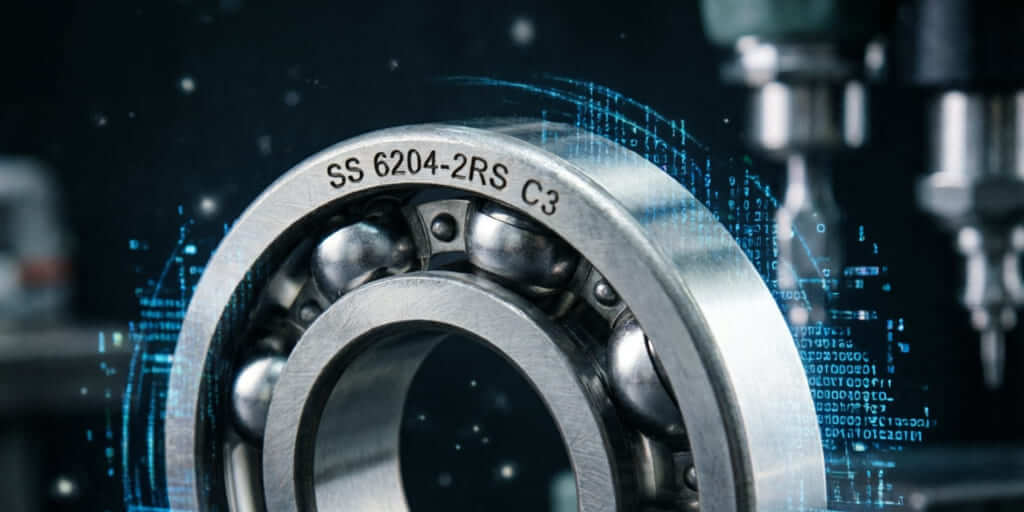
Whether you are a new procurement specialist sourcing components or a mechanical engineer verifying blueprints, looking at a long string of numbers and letters on a bearing can feel like trying to read a foreign language.
However, reading bearing numbers doesn't require memorization. The naming convention follows a strict, logical system. Over our 15 years in industrial manufacturing, we have seen that once you understand the basic formula, you can decode almost any bearing's specifications at a glance.
Here is the master formula to immediately decode any standard metric bearing:
Complete Bearing Code = [Prefix] + [Basic Designation (Type + Series + Bore)] + [Suffix]
Let’s break down each of these three sections using clear, easy-to-read tables.
Part 1: The Basic Designation (The Core)
The basic designation is the "heart" of the bearing number, usually consisting of 3 to 5 digits. It tells you the bearing type, its toughness/size series, and the inner diameter (bore size).
1. Bearing Type (First Digit or Letter)
The very first character indicates the structural design of the bearing. Deep groove ball bearings are by far the most common in industrial applications, robotics, and motors.
| Code |
Bearing Type |
Common Applications |
| 6 |
Deep Groove Ball Bearing |
High speeds, radial loads (e.g., electric motors, appliances) |
| 7 |
Angular Contact Ball Bearing |
Combined radial and axial loads |
| 3 |
Tapered Roller Bearing |
Heavy loads, automotive hubs |
| N |
Cylindrical Roller Bearing |
High capacity radial loads (variants include NU, NJ) |
| 5 |
Thrust Ball Bearing |
Purely axial (thrust) loads |
| 1 or 2 |
Self-Aligning Ball Bearing |
Applications where shaft misalignment occurs |
2. Dimension Series (Second and Third Digits)
Following the type, the next one or two digits represent the dimension series. This tells you the Width and Outer Diameter (OD) relative to the bore size.
• Width Series: Typically 0, 1, 2, 3, or 4 (higher numbers mean a wider bearing).
• Outer Diameter Series: Typically 8, 9, 0, 1, 2, 3, or 4 (e.g., 0 is extra-light, 2 is light, 3 is medium, 4 is heavy-duty).
Note: Sometimes the width digit is omitted in standard deep groove ball bearings.
3. Bore Size / Inner Diameter (Last Two Digits)
This is the most critical measurement for fitting a bearing onto a shaft. The last two digits of the basic designation follow a specific multiplication rule.
| Last Two Digits |
Bore Size (Inner Diameter) |
Rule / Formula |
| 00 |
10 mm |
Standard Exception |
| 01 |
12 mm |
Standard Exception |
| 02 |
15 mm |
Standard Exception |
| 03 |
17 mm |
Standard Exception |
| 04 and above |
Multiply by 5 |
e.g., 04 x 5 = 20 mm |
| 08 |
Multiply by 5 |
e.g., 08 x 5 = 40 mm |
(Miniature bearings, like the popular 608 used in high-speed appliances and small automation arms, follow a different rule where the single last digit directly equals the bore size in mm: 8 = 8mm).
Part 2: Decoding Suffixes (Seals, Clearance, and Precision)
Suffixes are added to the end of the basic designation to indicate specific internal designs, sealing, lubrication, and tolerances.
Shields and Seals
These keep lubrication in and contaminants out.
| Suffix |
Meaning |
Characteristic |
| Z / ZZ |
Metal Shield |
Low friction, one side (Z) or both sides (ZZ) |
| RS / 2RS |
Rubber Seal |
Better protection against dust/water, slight friction |
| Open |
No Suffix |
Unsealed, requires external lubrication system |
Internal Clearance
Radial internal clearance is the total distance one bearing ring can move relative to the other. Selecting the right clearance is vital for heat expansion in high-speed machinery.
| Suffix |
Clearance Level |
Application Profile |
| C2 |
Less than normal |
High precision, low vibration needs |
| CN (or None) |
Normal clearance |
Standard operating conditions |
| C3 |
Greater than normal |
High temperatures, electric motors |
| C4 |
Greater than C3 |
Extreme heat applications |
| CM |
Special clearance |
Optimized for electric motors to reduce noise |
Precision Grades (Tolerance)
Standardized by ISO 492, precision grades dictate the manufacturing exactness of the bearing.
| Suffix |
ISO Precision Grade |
Use Case |
| P0 (or None) |
Normal Precision |
Standard industrial applications |
| P6 |
Higher Precision |
General machinery |
| P5 |
High Precision |
High-speed applications (e.g., medical handpieces, robotics) |
Part 3: Decoding Prefixes (Materials)
Prefixes are less common but are typically used to denote the core material of the bearing if it is not standard chrome steel.
| Prefix |
Meaning |
| S or SS |
Stainless Steel (Corrosion resistant) |
| F |
Flanged Outer Ring |
| W |
Wide variant |
Putting It All Together: A Real-World Example
Let's apply the formula to a very common industrial part number: SS 6204-2RS C3 P5
➀ SS (Prefix): Made of Stainless Steel.
➁ 6 (Type): Deep Groove Ball Bearing.
➂ 2 (Dimension Series): Light series outer diameter.
➃ 04 (Bore Size): 04 x 5 = 20mm inner diameter.
➄ -2RS (Seal Suffix): Rubber seals on both sides.
➅ C3 (Clearance Suffix): Greater than normal internal clearance (great for heat expansion).
➆ P5 (Precision Suffix): High precision manufacturing grade.
By breaking the code into these specific segments, you can confidently identify and procure the exact components required for your engineering projects without second-guessing the specifications.
Feel free to reach out for technical support or product recommendations.