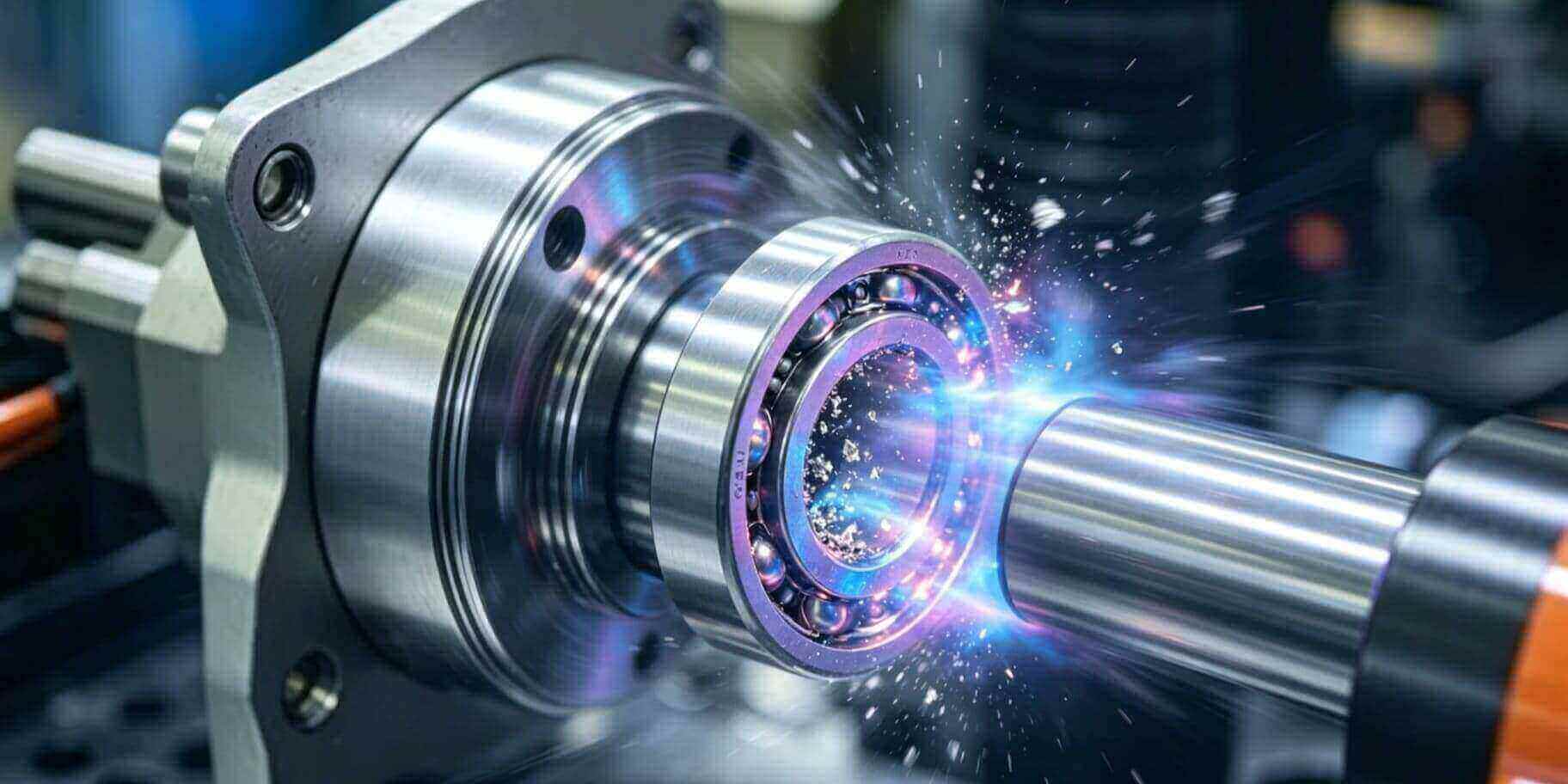
A customer recently came to me frustrated, saying: "Your 6204 bearing is terrible, my spindle is vibrating like crazy."
I asked for a photo of his setup. It turned out he had installed a deep groove ball bearing on a high-precision spindle dealing with heavy axial loads.
The bearing wasn’t bad at all. The choice was just wrong. It’s like putting a weightlifter in a wrestling match, they are undeniably strong, but in that specific environment, they will lose.
Here is a quick breakdown of why this happens and how to make sure you never make the same costly mistake.
The Analogy: The Weightlifter vs. The Wrestler
To understand the fundamental difference between these two common bearings, think of them like athletes:
| Bearing Type |
The Analogy |
| Deep Groove Ball Bearing |
Like a weightlifter: Standing with straight arms (0° contact angle). They are incredibly strong when pushing straight down (radial load) but weak if you try to pull them from the side (axial load). |
| Angular Contact Ball Bearing |
Like a wrestler: Standing in an angled, braced stance (15°–40°). They are designed to handle both pushing and pulling at the same time, easily taking on tilting and combined loads. |
Technical Comparison: Which Bearing Wins?
To make your engineering decisions easier, here is a clear side-by-side comparison:
| Parameter |
🟢 Deep Groove Ball Bearing |
🔵 Angular Contact Ball Bearing |
| Main Strength |
Cost-effective, fast, quiet, and widely available. |
High rigidity, easily handles combined axial and tilting loads. |
| Weakness |
Poor axial load capacity; cannot be paired. |
More expensive; requires pairing; directional installation. |
| Contact Angle |
≈ 0° |
15° / 25° / 40° |
| Can be Preloaded? |
❌ No |
✅ Yes (Significantly increases rigidity) |
| Installation |
Easy: No specific direction or pairing required. |
Critical: Direction matters; usually requires factory-matched pairs. |
| Precision Grade |
P0 / P6 / P5 / P4 |
P6 / P5 / P4 / P2 |
| Common Codes |
Starts with 6 (e.g., 6000, 6200, 6300 series, MR/R series). |
Starts with 7 (e.g., 7000, 7200, 7300 series). |
| Best Applications |
Motors, water pumps, fans, home appliances, power tools, conveyors, and general gearboxes. |
Machine tool spindles, CNC routers, precision pumps, auto gearboxes, high-speed centrifuges, and precision robotics. |
Pro Tip: 3 Standard Pairing Methods for Angular Contact Bearings
If you are using Angular Contact bearings, understanding how to pair them is what separates professionals from beginners.
| Code |
Pairing Name |
What It Does |
Best Application |
| DB |
Back-to-Back |
Offers the highest rigidity and resists tilting moments perfectly. |
Machine tool spindles, precision rotary axes. |
| DF |
Face-to-Face |
Allows for minor shaft misalignment or deflection. |
Pumps, general gearboxes. |
| DT |
Tandem |
Doubles the axial load capacity (but in one direction only). |
Heavy-duty compressors, screw pumps. |
Engineer's Rule of Thumb: DB is the most common configuration for high-precision applications. When in doubt, start with DB.
Quick Decision Guide: What Does Your Machine Need?
Still hesitating? Ask yourself these 3 simple questions:
① Does your application have significant axial (push/pull) load?
No → Deep Groove ✅
Yes → Angular Contact ✅
② Do you need high rigidity or high positional accuracy?
No → Deep Groove is fine
Yes → Angular Contact (DB pairing)
③ Is budget the #1 strict constraint?
Yes → Deep Groove
No, long-term reliability matters more → Angular Contact
Putting an Angular Contact bearing where a Deep Groove works is just a waste of money. But putting a Deep Groove where an Angular Contact is needed equals machine failure.
Not sure which bearing fits your specific application?
We are here to help. Leave a comment below or send an email to sales@welinkbearing.com. Just tell us your machine type, operating speed, and load direction, and our Welink Bearing engineering team will recommend the perfect model for your setup.