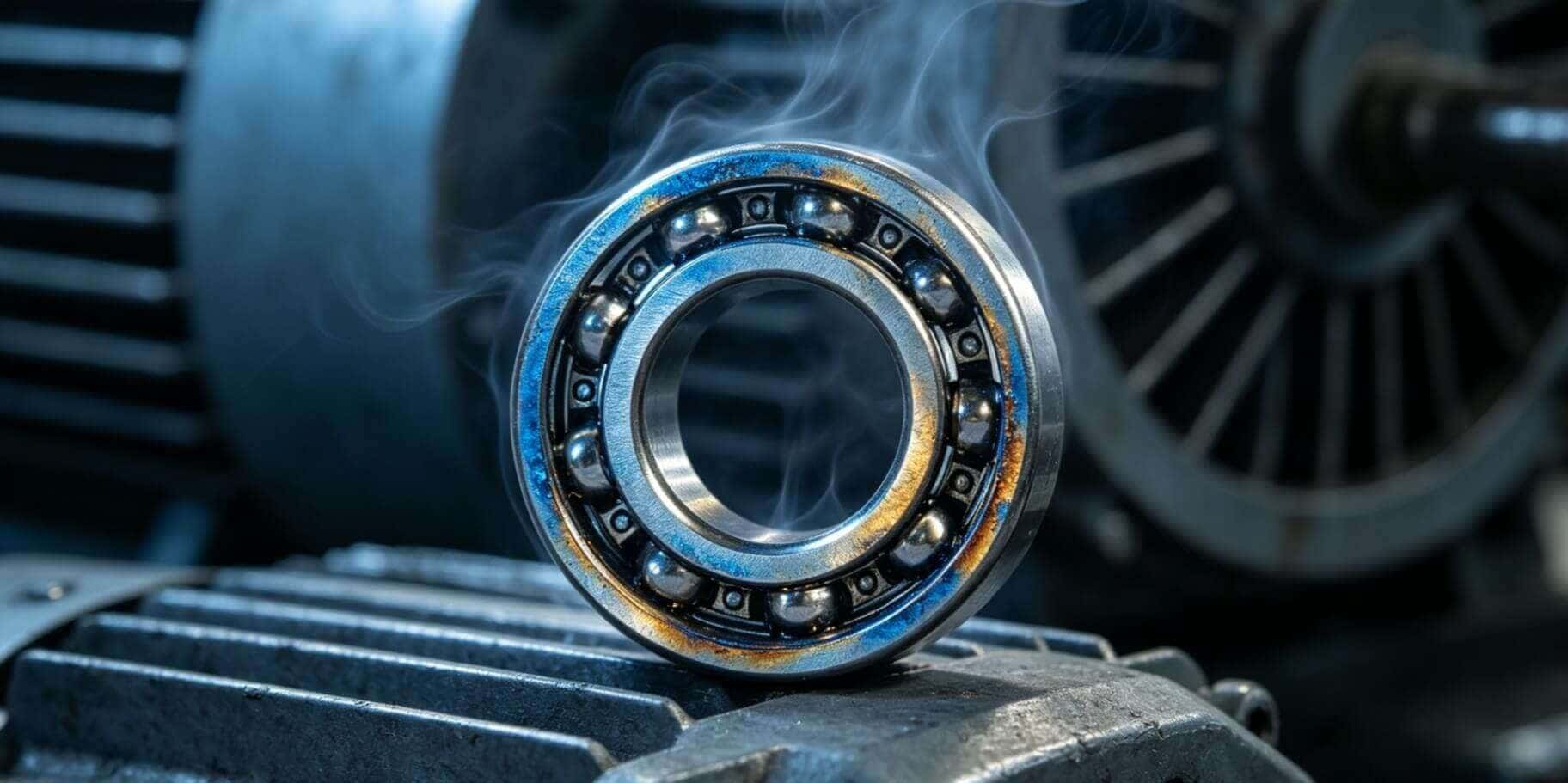
Small bearings are widely used in electric motors, fans, power tools, and precision equipment. Yet one problem keeps coming up in real applications: overheating. If you’ve ever touched a running motor housing and felt it hotter than expected, the bearings are often part of the issue. So why do small bearings overheat, and more importantly, how can you prevent it?
① Excessive Preload or Excessive Interference Fit
One of the most common causes is an overly tight fit between the shaft and the bearing. For deep groove ball bearings, overheating is more often caused by excessive interference fit rather than axial preload.
• What happens: Too much interference fit reduces internal clearance, sometimes into negative range leading to higher friction and rapid heat generation.
• In practice: This often occurs when tolerances are not properly controlled during assembly.
• What to do: Always follow the manufacturer’s recommended shaft and housing fits especially in high-speed applications.
② Incorrect Bearing Clearance
Clearance plays a critical role in controlling temperature.
• Too little clearance → Increased friction and heat buildup (negative clearance causes rolling element stress)
• Too much clearance → Vibration, which also generates heat
• Tip for small electric motors: Choosing the right clearance is essential. Common options include C0 (Normal / CN), C3, and CM (motor-specific clearance).
CM is specially designed for electric motors. Its clearance value lies between standard CN (C0) and C3, but with a narrower and tighter tolerance range. This provides a better balance against thermal expansion while controlling noise and vibration.
③ Poor Lubrication
This is probably the most overlooked factor. Common mistakes include:
• Adding too much grease → Causes churning and extra heat
• Using too little grease → Leads to metal-to-metal contact
• Choosing the wrong type of grease → Poor performance at operating temperature
I’ve seen motors fail simply because the grease filled over 80% of the bearing cavity.
Best practice:
• For small bearings (e.g., 6000 series), keep grease fill between 25% and 35% of the internal free space.
• For high-speed applications (>10,000 rpm), reduce to 15–25%.
Unless the manufacturer specifies otherwise, stay closer to the lower end for high speeds.
④ Contamination
Dust, metal particles, or moisture inside the bearing dramatically increase friction.
• Result: Higher temperatures, faster wear, and eventual failure.
Prevention tips:
• Use sealed or shielded bearings (ZZ or 2RS) whenever possible.
• Maintain a clean installation environment.
⑤ Misalignment
Even slight misalignment causes uneven load distribution.
• What happens: Localized stress increases friction and leads to overheating.
⑥ Operating Beyond Speed Limits
Small bearings are often pushed to high speeds, but every bearing has its limit. Pay attention to both grease life limit and thermal speed rating, not just the limiting speed in catalogs. Running above the recommended speed sharply increases friction and heat.
Overheating is rarely caused by a single factor. In most cases, it’s a combination of fit, lubrication, clearance, and installation quality. If you’re facing overheating issues, don’t just replace the bearing, step back and review the entire system.
About Welink Bearing
At Welink Bearing, we don’t just supply bearings, we help customers solve real application problems. Whether you’re dealing with overheating, noise, or short service life, our team can recommend the right bearing, clearance (including C0, C3, and CM motor clearance), and lubrication solution for your specific application.
Feel free to reach out for technical support or product recommendations.