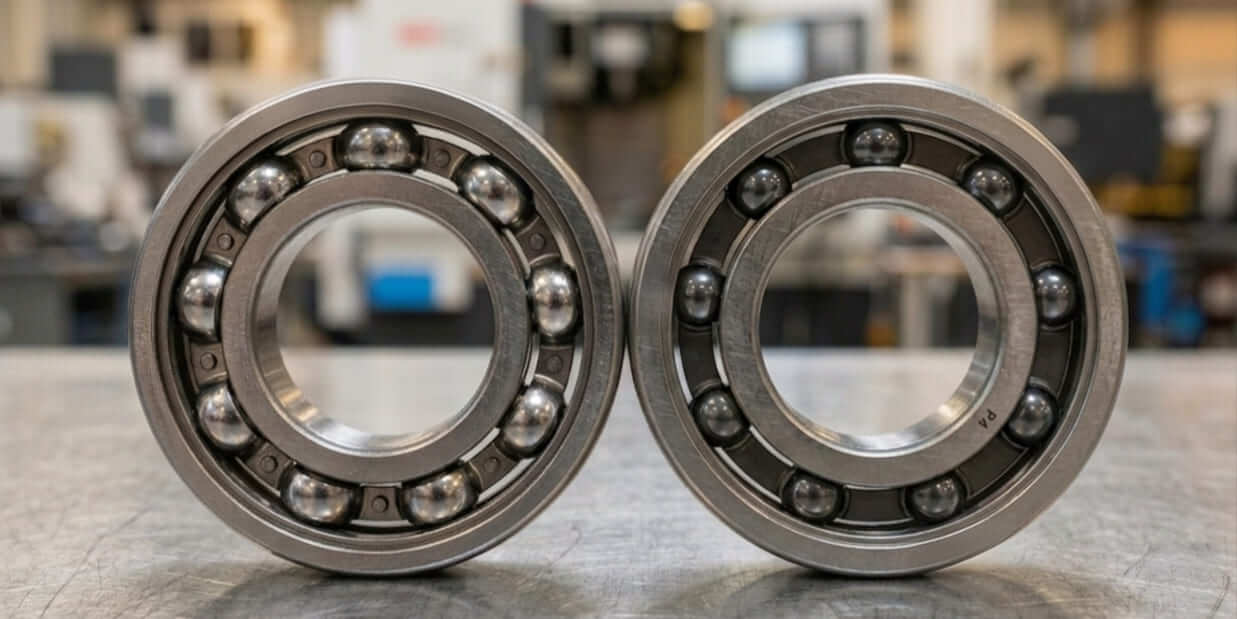
As modern industries push the limits of speed and efficiency, engineers are constantly battling two major enemies: heat and friction. Whether you are designing motors for high-performance UAVs (drones), precision CNC spindles, or next-generation electric vehicles, the components you choose can make or break the system.
At Welink Bearing, we often get asked by technicians and procurement managers: Should we stick with traditional steel bearings, or is it time to upgrade to hybrid ceramic bearings? In this comprehensive guide, we will break down the exact differences between steel and hybrid ceramic bearings in terms of heat dissipation, weight, and electrical insulation to help you make the right engineering decision.
What is a Hybrid Ceramic Bearing?
Before diving into the comparison, it is important to clarify what a "hybrid" bearing is. A hybrid ceramic deep groove ball bearing consists of traditional steel inner and outer rings (usually 52100 Chrome Steel or 440C Stainless Steel), but the rolling elements (the balls) are made from bearing-grade ceramic material, most commonly Silicon Nitride (Si3N4).
This combination offers the durability of steel rings combined with the extreme performance characteristics of ceramic balls. Full ceramic bearings (where rings and balls are both ceramic) also exist, but hybrids are the gold standard for most high-speed industrial applications due to their balance of performance and cost.
Hybrid Ceramic vs. Steel: The High-Speed Showdown
When an application requires ultra-high RPMs, the physical properties of the bearing material are put to the ultimate test. Here is how hybrid ceramics stack up against standard steel bearings.
① Speed and Heat Dissipation
In high-speed motors, friction generates extreme heat. If the heat exceeds the bearing's thermal limits, the lubricant degrades, leading to catastrophic failure.
• Steel Bearings: At very high speeds, steel balls expand due to heat. This thermal expansion reduces the internal clearance of the bearing, increasing friction and creating a vicious cycle of overheating.
• Hybrid Ceramic Bearings: Silicon Nitride balls have a drastically lower coefficient of thermal expansion (about 25% that of steel). They retain their size and shape even at extreme temperatures. Furthermore, ceramic balls have a superior surface finish, meaning less friction and significantly better heat dissipation. As a result, hybrid bearings can typically run 20% to 30% faster than their steel counterparts.
② Weight and Centrifugal Force (The UAV Advantage)
For drone manufacturers and aerospace engineers, every gram matters.
• Steel Bearings: Steel is dense. At ultra-high RPMs, the weight of the steel balls creates immense centrifugal force against the outer ring, accelerating wear and tear (skidding).
• Hybrid Ceramic Bearings: Ceramic balls are approximately 40% lighter than steel balls. This dramatic weight reduction means drastically lower centrifugal forces at high speeds, resulting in smoother operation, longer fatigue life, and reduced energy consumption. For UAV motors, this translates directly to longer battery life and more stable flight dynamics.
③ Electrical Insulation (Protecting Electric Motors)
With the rise of Variable Frequency Drives (VFDs) and high-power electric motors, electrical pitting has become a primary cause of bearing failure.
• Steel Bearings: Steel is highly conductive. Stray electrical currents (shaft voltages) can arc through the bearing from the inner ring to the outer ring. This arcing melts microscopic pits into the steel, eventually causing a "fluting" pattern that destroys the bearing and causes severe noise.
• Hybrid Ceramic Bearings: Silicon Nitride is a natural electrical insulator. The ceramic balls act as a barrier, preventing stray currents from passing through the bearing. Upgrading to hybrid bearings is often the most effective, permanent solution to electrical arcing in modern electric motors.
Comparison Table: Hybrid Ceramic vs. Steel Bearings
| Feature |
Standard Steel Bearings (GCr15) |
Hybrid Ceramic Bearings (Si3N4 Balls) |
| Max Speed (RPM) |
High |
Ultra-High (Up to 30% faster) |
| Weight of Balls |
Standard (Dense) |
~40% Lighter |
| Heat Generation |
Moderate to High at peak speeds |
Very Low (Superior heat dissipation) |
| Electrical Insulation |
Conductive (Risk of electrical arcing) |
Fully Insulated |
| Thermal Expansion |
High (Requires strict clearance control) |
Minimal (Stable internal clearance) |
| Cost |
Cost-Effective |
Premium Investment |
| Best Used For |
Standard motors, pumps, household appliances |
UAVs, VFD electric motors, CNC spindles |
The Verdict: Are They Worth the Upgrade?
The short answer is: It depends on your specific application.
Stick with Steel Bearings if:
• Your application runs at standard speeds (e.g., standard HVAC fans, basic water pumps).
• You are operating under very heavy shock loads (ceramic balls are harder, but can be more brittle under extreme impact than steel).
• Budget is the primary constraint. At Welink Bearing, our high-precision steel deep groove ball bearings (up to ABEC-5/P5 grades) are more than capable of handling 90% of standard industrial tasks.
Upgrade to Hybrid Ceramic Bearings if:
• You are manufacturing UAV/Drone motors where weight reduction and high RPMs are critical.
• You are dealing with electric motor bearing failures caused by electrical arcing/stray currents.
• You need extreme longevity in high-speed applications (like high-speed routers, dental drills, or precision robotics) where maintenance downtime is costly.
Frequently Asked Questions (FAQs)
Q1: Do hybrid ceramic bearings need lubrication?
Yes. While ceramic balls have a much lower coefficient of friction and can technically run dry longer than steel, they still require lubrication (grease or oil) to protect the steel races and dissipate residual heat. However, they require significantly less lubricant than standard steel bearings.
Q2: Are ceramic bearings more fragile than steel?
Silicon Nitride is much harder than bearing steel, which makes it incredibly wear-resistant. However, because it is stiffer, it is slightly more brittle. They excel in high-speed, continuous-rotation applications but are not recommended for applications subject to massive, sudden shock loads.
Q3: Can Welink Bearing customize hybrid ceramic bearings?
Absolutely. As a dedicated manufacturer, Welink Bearing can customize hybrid ceramic deep groove ball bearings with specific clearances (C3, C4), specialized high-speed greases, and custom seals (ZZ, 2RS, or non-contact seals) to perfectly match your project requirements.