Leave A Message
If you are interested in our products and want to know more details,please leave a message here,we will reply you as soon as we can.
Submit
Industry Blog
Home Industry Blog

Total Cost of Ownership (TCO): Why Cheap Bearings Cost More in the Long Run?

Total Cost of Ownership (TCO): Why Cheap Bearings Cost More in the Long Run?

Jun 04, 2026
William Carter - CEO ApexSync Technologies

I just want to say a massive thanks to Welink team. We had a really tight deadline for a prototype requiring specific deep groove ball bearings, and they were brilliant. They understood our needs immediately, rushed samples over, and followed up to ensure perfect performance. It's that attentive service that sets them apart. They've been a great help, and we're already looking forward to our next project together. Highly recommended.

William Carter - CEO ApexSync Technologies

Total Cost of Ownership (TCO) Why Cheap Bearings Cost More in the Long Run


Introduction: The $3 Bearing That Cost $30,000

A maintenance engineer at a food processing plant once replaced a worn bearing with the cheapest option he could find online, saving $4.70 per unit. Six weeks later, the bearing failed mid-production, contaminating a batch of product, shutting down the line for 19 hours, and triggering a full safety audit. The total incident cost exceeded $30,000.


This is not an exceptional story. It happens every day across manufacturing plants, automation systems, and precision machinery around the world. The culprit is almost never negligence, it is an incomplete understanding of Total Cost of Ownership (TCO).


When engineers and procurement teams evaluate bearings based on unit price alone, they are seeing only the smallest part of the cost picture. In this article, Welink Bearing breaks down the real economics of bearing selection, why low upfront costs routinely destroy machine TCO, and how to make smarter bearing decisions that protect your operations and your bottom line.


What Is Total Cost of Ownership (TCO) in Bearing Selection?

Total Cost of Ownership (TCO) is a financial framework that calculates the full lifecycle cost of an asset or component. Not just what you pay at purchase, but every dollar the component costs you from installation to disposal.


For bearings, TCO includes:

• Purchase price — the unit cost of the bearing itself

• Installation and labor costs — time required to install, align, and commission

• Lubrication and maintenance costs — ongoing servicing intervals and consumables

• Energy consumption — friction losses over the bearing's operating life

• Downtime costs — lost production during unplanned failures or scheduled maintenance

• Replacement frequency — how often the bearing must be swapped out

• Collateral damage — harm to shafts, housings, seals, and adjacent components caused by bearing failure

• Disposal and environmental costs — handling and compliance at end of life


When you compare a $3 bearing to a $12 bearing, you are comparing only the first item on this list. The remaining seven items are where the real cost story unfolds.


How to Calculate Bearing TCO: A Practical Formula?

 A simplified TCO formula for a single bearing position over a defined period:

TCO = (Purchase Price × Number of Replacements) + (Labor × Replacements) + Downtime Cost + Energy Losses + Collateral Damage


Let's apply this to a real-world comparison for a deep groove ball bearing in a continuous-duty conveyor motor, running 24/7 in a production environment.


Scenario: One Bearing Position Over 3 Years

Cost Category Cheap Bearing (Budget Grade) Premium Bearing (ISO/DIN Quality)
Unit purchase price $3.50 $14.00
Expected service life 6 months 24–36 months
Replacements in 3 years 6 1–1.5
Total purchase cost $21.00 $14–21.00
Labor per replacement (1hr @ $45/hr) $270.00 $45–67.50
Average downtime per failure (2hrs @ $500/hr) $6,000.00 $500–750.00
Energy loss (extra friction, 3yr estimate) $180.00 ~$0
Collateral damage (shaft wear, seal replacement) $320.00 ~$40.00
3-Year TCO ~$6,791 ~$600–880

The cheap bearing costs $3.50 at purchase. Its three-year TCO is nearly 8–11× higher than the premium alternative.


5 Hidden Costs of Cheap Bearings That Engineers Often Overlook

① Unplanned Downtime: The Single Largest Cost Driver

Unplanned downtime is the most devastating cost associated with premature bearing failure. Unlike scheduled maintenance, which can be planned around production windows, a bearing failure mid-shift triggers immediate line stoppage, emergency labor, and often cascading delays that ripple across an entire shift or day.


Industry benchmarks suggest that manufacturing downtime costs range from $260,000 to over $2 million per hour for large automotive or heavy industrial operations, and even small production lines regularly suffer losses of $500–$5,000 per hour of unplanned stoppage.


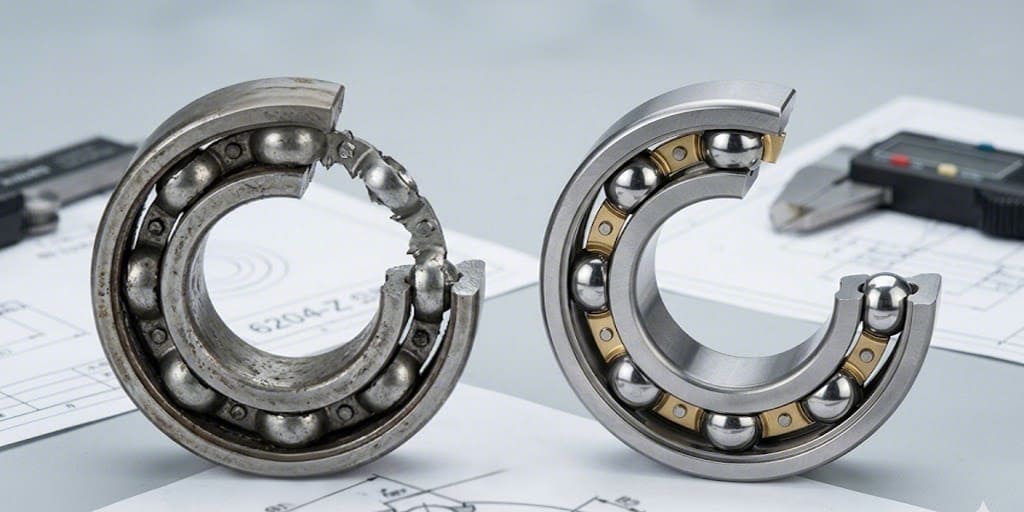
Budget bearings manufactured with lower-grade steel, inconsistent heat treatment, or poor dimensional tolerances are statistically far more likely to fail before their rated L10 life. A bearing that fails unpredictably is far more expensive than one that costs three times as much but lasts reliably.


Key insight: The economic justification for premium bearings often lives entirely in the downtime prevention they provide, even before considering any other cost category.


② Accelerated Wear on Mating Components

A bearing does not fail in isolation. When a low-quality bearing begins to degrade, developing surface fatigue, cage deformation, or raceway spalling. It introduces vibration, misalignment, and metallic debris into the bearing system. This does not just destroy the bearing itself; it attacks:

• Shafts and journals — fretting and fretting corrosion from micro-movement

• Housing bores — wear and out-of-roundness from bearing creep

• Seals and shields — accelerated wear from contamination and vibration

• Adjacent bearings — transmitted vibration reduces the life of neighboring positions


In miniature bearing applications, where tolerances are measured in micrometers, collateral damage from a failed low-quality bearing can destroy precision spindles, instrument shafts, or medical device components that cost hundreds of times more than the bearing itself.


Welink Bearing perspective: Our miniature deep groove ball bearings are manufactured to tight dimensional tolerances precisely because in small-form-factor applications, the collateral damage ratio is highest. A $1.50 saving on a miniature bearing can easily generate $200–$500 in downstream damage to precision assemblies.


③ Energy Inefficiency Over the Operating Life 

This cost is invisible on a procurement spreadsheet but accumulates continuously across the bearing's service life.


Bearings with poor surface finish on raceways and rolling elements generate higher frictional torque. In continuous-duty motors, pumps, fans, or conveyors, this additional friction translates directly into measurable energy waste. Studies on industrial bearing systems consistently show that substandard bearings can increase motor energy consumption by 2–8% compared to precision-grade equivalents.


For a 5.5kW conveyor motor running 8,000 hours per year at an electricity cost of £0.25/kWh:

• 5% energy penalty from a cheap bearing: 5.5 × 0.05 × 8,000 × £0.25 = £550/year per motor

Across a facility with 50 such motors: £27,500/year in wasted electricity


This is pure loss, invisible on the bearing line of a P&L, but very real on the energy bill.


④ Increased Maintenance Labor and Frequency

Budget bearings typically require more frequent inspection and replacement cycles. Each intervention requires:

• Taking equipment offline

• Disassembling housings or end plates

• Removing the old bearing (sometimes requiring heat or hydraulic tools)

• Cleaning the housing, shaft, and surrounding components

• Installing, aligning, and lubricating the new bearing

• Recommissioning and testing


For a simple bearing replacement, this process can take 1–4 hours per position. When multiplied by higher replacement frequency, the cumulative labor cost rapidly dwarfs the original purchase price savings.


There is also a less-discussed cost: skill degradation and human error risk. Every additional bearing replacement introduces an opportunity for incorrect installation, over-tightening, contamination during fitting, improper lubrication, or incorrect seating, each of which can accelerate failure of the replacement bearing itself.


⑤ Supply Chain Disruption and Emergency Procurement Costs

When a machine fails unexpectedly due to a bearing, procurement urgency drives costs in several ways:

• Emergency sourcing premiums: Expedited orders from distributors often carry 20–50% price surcharges

• Courier and express freight costs: Rush shipping of replacement parts can exceed the part cost itself

• Engineering overtime: Technician callout rates, weekend rates, and overtime add substantial labor cost

• Management time: Incident response, root cause analysis, and corrective action documentation consume valuable engineering and management hours


Premium bearings with predictable, extended service lives allow maintenance to be planned, parts to be stocked rationally, and interventions to be scheduled during planned downtime windows, eliminating nearly all emergency procurement costs.


What Makes a Premium Bearing Worth the Price?

Understanding TCO requires understanding why premium bearings outperform budget alternatives. The difference is not marketing, it is metallurgy, manufacturing precision, and quality control.


① Material Quality: Steel Cleanliness and Composition

Premium bearing steel, such as through-hardened 100Cr6 (AISI 52100) or case-hardened grades used in demanding applications, is produced with controlled chemistry and low inclusion content. Inclusions (microscopic non-metallic particles) in steel act as stress concentration points that initiate fatigue cracks under cyclic loading. Budget bearing manufacturers often use lower-grade steel with higher inclusion counts, directly reducing fatigue life.

Welink Bearing uses high-cleanliness steel for our deep groove ball bearings and miniature bearings to ensure fatigue resistance that meets or exceeds ISO rating predictions.


② Dimensional Precision and Geometric Tolerances

Bearing performance depends critically on dimensional accuracy, the roundness of raceways, the size consistency of rolling elements, and the precision of bore and outside diameter. ISO 492 defines tolerance classes from Normal to P2 (ultra-precision).

Budget bearings may meet nominal dimensions on average but exhibit high variance, meaning some units are within tolerance while others are not. This variance causes uneven load distribution, elevated vibration, and reduced life. Precision-manufactured bearings deliver consistent tolerance adherence across every unit in a batch.


③ Surface Finish of Raceways and Rolling Elements

The contact surfaces between rolling elements and raceways are subject to Hertzian contact stresses measured in GPa. Microscopic surface irregularities, measured as Ra surface roughness, directly influence the elastohydrodynamic (EHD) lubrication film that separates these surfaces under operation.

Rough raceway surfaces break down the lubrication film more quickly, increase metal-to-metal contact events, accelerate wear, and generate heat. Premium bearings achieve finer surface finishes through additional honing and superfinishing operations, extending oil film life and dramatically reducing wear rates.


④ Heat Treatment Consistency

The hardness profile of bearing rings and rolling elements must be carefully controlled through heat treatment. Inadequate or inconsistent heat treatment results in bearings that are either too soft (leading to rapid wear and indentation) or improperly through-hardened (leading to brittle fracture). Premium manufacturers employ tightly controlled continuous furnace or batch heat treatment processes with full traceability, ensuring every bearing meets the required hardness profile of 58–65 HRC at the working surfaces.


⑤ Cage Design and Material

The bearing cage (retainer) separates and guides the rolling elements. In budget bearings, cages are often made from low-grade pressed steel with rough edges and poor dimensional consistency. This leads to ball-to-cage friction, cage instability at high speeds, and cage fracture under dynamic loading.

Premium bearings use machined brass cages, polyamide (PA66) injection-moulded cages, or stamped high-quality steel cages depending on application requirements, each designed to maintain stable ball guidance across the full operating speed and load range.


⑥ Sealing and Lubrication Quality

The seals or shields in a sealed/pre-lubricated bearing determine contamination resistance and grease retention, two of the primary factors controlling service life in real operating environments. Budget sealed bearings frequently use low-contact rubber seals with poor lip conformity or simple non-contact shields that offer minimal protection.

Premium bearings are filled with high-quality lithium-complex or synthetic base greases, precisely metered to fill the correct proportion of internal free volume, avoiding both under-greasing (leading to dry running) and over-greasing (leading to churning heat generation and seal blowout).


Deep Groove Ball Bearings: TCO in Common Industrial Applications

Deep groove ball bearings (DGBBs) are the most widely used bearing type globally, found in electric motors, pumps, fans, conveyors, gearboxes, and thousands of other applications. Their TCO implications are enormous in aggregate.


Electric Motors

In a standard IEC frame induction motor, bearings account for roughly 50–65% of all motor failures. Premium DGBB selection in motor applications directly reduces motor replacement frequency, rewind costs, and associated downtime. For a population of 100 motors in a manufacturing facility, upgrading from budget to premium bearings can reduce bearing-related motor failures by 60–80% over a three-year period.


Pumps

Pump bearing failures frequently cause seal damage, shaft damage, and in the case of process pumps, product loss or contamination. A sealed DGBB failure in a centrifugal pump handling aggressive process fluid can trigger a cascading failure that includes mechanical seal replacement, shaft reconditioning, and impeller inspection, each a significant cost amplifier beyond the bearing itself.


Conveyor and Drive Systems

Conveyors are the circulatory system of manufacturing plants. A single bearing failure on a conveyor drive can halt material flow across an entire production area. Given that conveyors often operate in environments with vibration, temperature cycling, dust, and moisture, bearing quality particularly in sealing and cage robustness, has an outsized impact on total system availability.


Miniature Bearings: Where TCO Sensitivity Is Highest?

Miniature bearings (bore diameters typically 1–10mm) present a particularly compelling TCO case for premium selection, for two key reasons.


First, the collateral damage ratio is extreme. A miniature bearing in a dental handpiece, precision instrument, optical scanner, or medical device is often mounted in a precision housing machined to micron-level tolerances. A failed miniature bearing that causes housing bore damage can render an expensive component irreparable, a $2 bearing failure leading to a $500 component write-off.


Second, the cost of downtime per bearing position is disproportionately high. Miniature bearings appear in high-value equipment where downtime is extremely expensive. A miniature bearing failure in a semiconductor wafer handling robot, for instance, can halt a process line where hourly output value is measured in tens of thousands of dollars.


At Welink Bearing, our miniature deep groove ball bearings are manufactured with tight ABEC 5 and ABEC 7 tolerance class options, premium steel grades, and precision-filled lubrication, specifically because we understand the TCO environment in which these components operate.


How to Evaluate Bearing Suppliers on TCO, Not Just Price?

Making smart bearing procurement decisions requires asking different questions of your suppliers.

1. What steel grade and cleanliness level is used?  

Ask for material certifications or mill test reports. Reputable manufacturers can provide this documentation.

2. What tolerance class does this bearing meet?  

ISO Normal, P6, P5, P4, or P2 and can the supplier demonstrate dimensional measurement data?

3. What is the rated L10 life under my operating conditions?  

Ask the supplier to run an L10 life calculation using ISO 281 (including the a₁ and aISO life modification factors) for your specific load, speed, and temperature conditions.

4. What is the cage material and design?  

Is it appropriate for your operating speed, temperature, and dynamic load profile?

5. What grease is used in sealed bearings, and what is its temperature and speed range?  

Does it match your application's operating environment?

6. Does the supplier offer application engineering support?  

A supplier who can help you select the right bearing for your specific conditions is far more valuable than one who simply quotes the cheapest stock item.


Welink Bearing provides full technical support for bearing selection across our deep groove ball bearing and miniature bearing product ranges. Our engineering team can assist with L10 life calculations, fit and tolerance recommendations, and seal selection to ensure the bearing you choose delivers the TCO performance your operation requires.


Building a TCO-Based Bearing Procurement Policy

For maintenance and procurement managers looking to implement a TCO-based approach to bearing selection, the following framework provides a practical starting point.

Step 1 — Criticality Classification  

Classify each bearing position by equipment criticality: Critical (failure causes immediate production stoppage), Important (failure causes degraded operation), or Standard (failure can be tolerated until scheduled maintenance). Apply the most rigorous quality standards to Critical positions.

Step 2 — Baseline TCO Calculation  

For each Critical and Important position, calculate the current annual TCO using actual maintenance records, hourly downtime cost data, and energy monitoring where available.

Step 3 — Supplier Qualification  

Qualify bearing suppliers not just on price but on documentation capability, tolerance class, material certification, and technical support quality. Approved supplier lists should reflect TCO capability, not just unit cost.

Step 4 — Life Monitoring and Feedback  

Track bearing replacement frequency and failure modes. Use vibration monitoring or temperature trending where economically justified. Feed this data back into your TCO model and procurement specifications on an annual basis.

Step 5 — Standardization  

Where possible, standardize on a reduced number of bearing types from qualified suppliers. Standardization reduces inventory complexity, improves technician familiarity, and enables volume pricing from quality suppliers, combining the cost benefits of consolidation with the TCO benefits of quality.


Frequently Asked Questions: Bearing TCO

 Q: Are premium bearings always worth the extra cost?  

Not universally. In truly non-critical, low-speed, easily accessible applications with negligible downtime cost, budget bearings may be economically rational. However, in any application with meaningful downtime cost, continuous duty cycles, or precision requirements, premium bearings almost always deliver superior TCO.

Q: How much longer do premium bearings last compared to budget ones?  

Service life differences of 3–10× are common in controlled comparisons. The gap widens in demanding environments (high load, high speed, elevated temperature, contamination exposure) where manufacturing quality has the greatest influence on performance.

Q: Can I improve cheap bearing performance with better lubrication?  

Better lubrication improves bearing performance for any bearing, but it cannot compensate for fundamental material or dimensional deficiencies in a budget bearing. You will see improved performance at the margin, but the ceiling is set by the bearing's intrinsic quality.

Q: How do I convince procurement to approve a higher bearing unit cost?  

Present a TCO calculation that includes documented downtime cost, replacement frequency, and labor data from your actual maintenance records. When procurement can see that a $10 bearing saves $500 in annual TCO compared to a $2.50 bearing, the argument for unit price is unsustainable.

Q: Does Welink Bearing offer technical selection support?  

Yes. Our engineering team provides bearing selection guidance, L10 life calculation support, and application-specific recommendations for deep groove ball bearings and miniature bearings across a wide range of industries. Contact us with your application parameters and we will help you identify the most cost-effective solution for your TCO requirements.


Conclusion: Buy the Right Bearing, Not the Cheapest Bearing

The bearing is rarely the most expensive component in any machine, but it is frequently the component whose failure is most expensive. A deep groove ball bearing the size of a coin, if chosen incorrectly, can halt a production line, damage expensive machinery, trigger safety incidents, and generate costs that dwarf the savings from selecting the cheaper option.


Total Cost of Ownership is not a theoretical concept. It is a practical financial reality that shows up in maintenance budgets, energy bills, downtime records, and component replacement logs every day. The engineers and maintenance managers who apply TCO thinking to bearing selection, factoring in service life, failure consequences, energy efficiency, and maintenance frequency alongside unit price, consistently achieve lower real costs and higher machine availability than those who optimize for purchase price alone.


At Welink Bearing, we manufacture deep groove ball bearings and miniature bearings for customers who understand this distinction. Our products are built to deliver reliable, predictable performance over extended service lives, because we know that is what actually reduces the cost of operating your machinery.


Ready to evaluate your bearing TCO? Contact the Welink Bearing engineering team for application-specific selection support, life calculations, and product recommendations tailored to your operating conditions.


Welink Bearing — Specialized Manufacturer of Deep Groove Ball Bearings and Miniature Bearings  

For technical inquiries and bearing selection support, contact our engineering team.

Leave A Message

Leave A Message
If you are interested in our products and want to know more details,please leave a message here,we will reply you as soon as we can.
Submit

Home

Products

whatsApp

contact