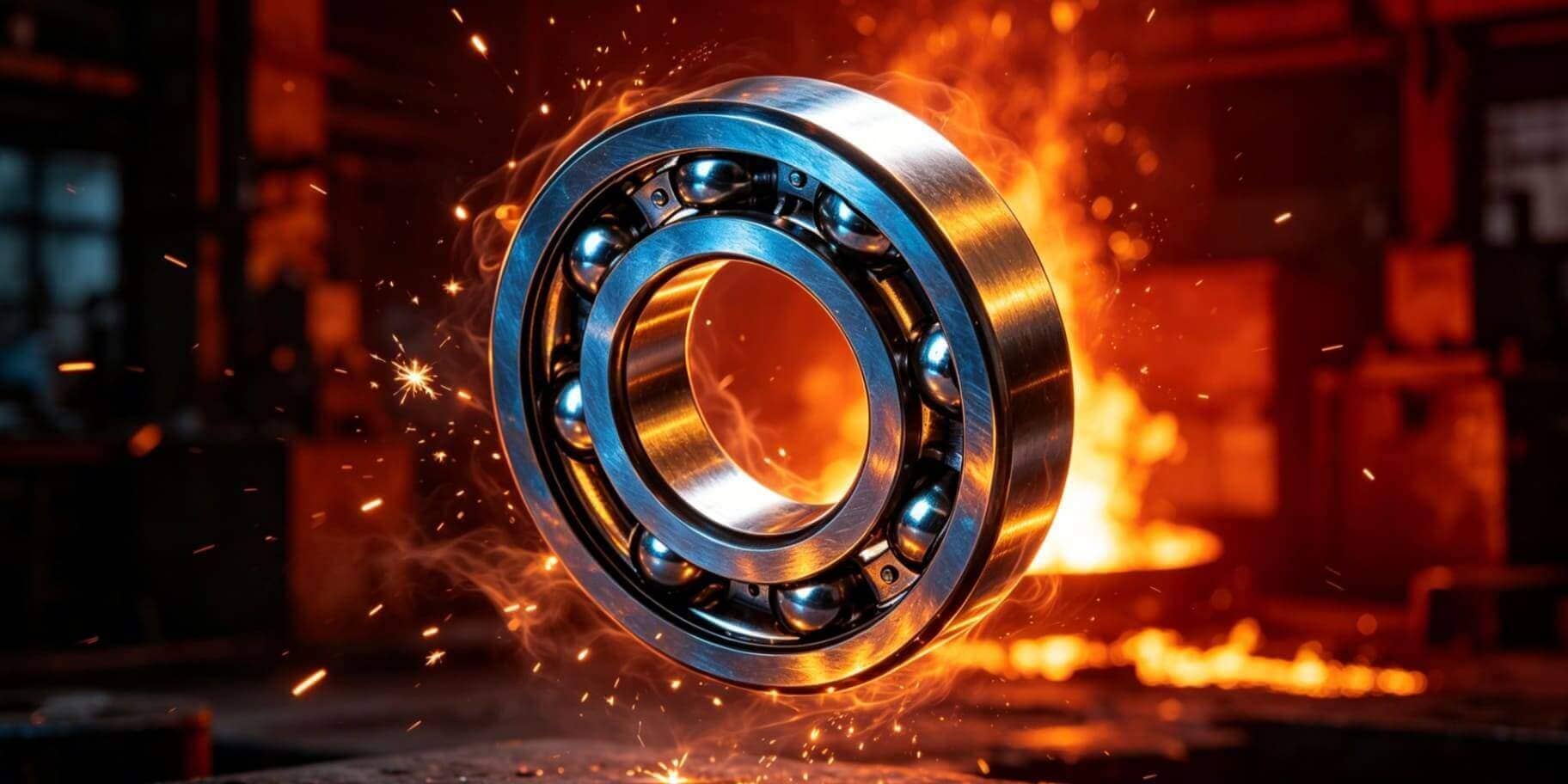
Temperature is one of the most critical and most underestimated factors in bearing selection. Engineers often focus on load ratings, bore size, and speed, only to discover that a bearing fails prematurely because it simply ran too hot.
So, what temperature can deep groove ball bearings actually handle?
The honest answer is: it depends. Standard deep groove ball bearings made from chrome steel can handle up to 120°C (248°F) in normal operating conditions. But the true thermal limit of any bearing is not determined by the steel alone. It is governed by a combination of factors: the ring material and heat stabilization treatment, the lubricant (grease) type, the cage material, and the seal or shield design.
This guide breaks down each of these factors clearly and practically, so you can select the right deep groove ball bearing for your thermal environment the first time.
Why Operating Temperature Matters for Bearings?
Before diving into specific numbers, it helps to understand what actually happens when a bearing gets too hot.
Dimensional Instability
Chrome steel bearings (GCr15 / 52100 steel) are heat-treated during manufacturing to achieve precise hardness and dimensional tolerances. When the bearing is exposed to temperatures beyond its heat stabilization limit, the microstructure of the steel begins to change. The rings and rolling elements can expand, soften, or undergo dimensional growth — a phenomenon known as martensitic transformation. This causes the internal clearance to change unpredictably, leading to increased noise, vibration, and ultimately bearing seizure.
Grease Degradation
All bearing greases have an upper operating temperature limit. When exceeded, the grease loses viscosity, oxidizes, and begins to break down chemically. Once the grease film collapses, metal-to-metal contact begins, friction spikes, and the bearing wears rapidly. Overheating is, in fact, one of the leading causes of premature bearing failure globally.
Seal and Cage Failure
Rubber seals and polymer cages also have strict temperature ceilings. A standard nitrile rubber (NBR) seal will harden and crack beyond 100°C. A polyamide (PA66) cage will warp and lose structural integrity above approximately 120°C. Both failures introduce contamination or uneven ball spacing — triggering cascading damage.
Standard Operating Temperature Range for Deep Groove Ball Bearings
For most standard deep groove ball bearings using chrome steel (GCr15 / AISI 52100), the accepted operating temperature range is:
| Condition |
Temperature Range |
| Minimum operating temperature |
−20°C (−4°F) |
| Normal operating temperature |
−20°C to +120°C |
| Short-term peak temperature |
up to +150°C (with standard grease risk) |
**Important: The 120°C figure assumes the bearing is operating under its rated load, at normal speed, and with appropriate standard lubrication. Exceeding any one of these conditions simultaneously with high temperature accelerates failure significantly.
Factor 1: Steel Material and Heat Stabilization
The ring and ball material defines the foundational temperature ceiling of a deep groove ball bearing. To extend this ceiling, manufacturers apply supplementary tempering treatments that stabilize the steel's microstructure at elevated temperatures. These treatments are coded by a suffix in the bearing designation.
Chrome Steel (GCr15 / 52100) — Standard and Heat-Stabilized Variants
| Heat Stabilization Code |
Max Dimensional Stability Temperature |
Typical Application |
| No suffix (standard) |
120°C (248°F) |
General purpose motors, pumps, fans |
| S1 (or SH) |
150°C (302°F) |
Automotive wheel bearings, higher-temp motors |
| S2 |
200°C (392°F) |
Industrial ovens, drying equipment |
| S3 |
250°C (482°F) |
Steel mills, glass processing machinery |
| S4 |
300°C (572°F) |
Extreme heat environments, specialty industrial |
Note: Heat stabilization does increase temperature resistance, but it slightly reduces hardness and therefore load-carrying capacity. Always verify with your bearing supplier that the reduced dynamic load rating still meets your application requirements.
Stainless Steel Bearings (AISI 440C / SUS440C)
Stainless steel deep groove ball bearings offer good corrosion resistance and a similar operating temperature range to standard chrome steel, typically up to 150°C. However, stainless steel is inherently softer than GCr15, resulting in lower dynamic load ratings (typically 20–30% lower). They are not inherently "high-temperature" bearings; their primary advantage is corrosion resistance in wet, chemical, or food-grade environments.
Ceramic Bearings (Silicon Nitride Si₃N₄ Balls)
Hybrid ceramic bearings — which use silicon nitride (Si₃N₄) balls combined with steel rings, represent the upper frontier of thermal performance. Silicon nitride is harder, lighter, and has a much lower thermal expansion coefficient than steel. These bearings can sustain continuous operation at temperatures up to 300°C or beyond, with significantly reduced heat generation at high speeds. They are used in demanding applications such as high-speed machine tool spindles, turbomachinery, and aerospace components.
Factor 2: Grease Type and Temperature Range
Even if the bearing steel can handle 200°C, the grease may fail at 130°C. The weakest thermal link in the bearing system determines the real operating limit. Here is a practical comparison of common grease types used in deep groove ball bearings:
| Grease Type |
Thickener |
Lower Limit |
Upper Limit |
Typical Application |
| Lithium grease (standard) |
Lithium soap |
−20°C |
+120°C |
General-purpose motors, household appliances |
| Lithium complex grease |
Li-complex |
−30°C |
+150°C |
Automotive, industrial motors |
| Polyurea grease |
Polyurea |
−30°C |
+160°C |
Electric motors (long life, non-regreased) |
| Calcium sulfonate complex |
Ca-sulfonate |
−20°C |
+180°C |
High-load, water-contaminated environments |
| Silicone grease |
Silicone |
−60°C |
+200°C |
Food-grade, electrical insulation application |
| PFPE / PTFE grease |
PTFE |
−50°C |
+260°C |
Ultra-high temperature, vacuum, aerospace |
Practical takeaway: For most electric motor and pump applications operating between 80°C and 130°C, a polyurea-based grease is the recommended choice. It offers excellent oxidation stability, long service life, and compatibility with standard seals. For applications pushing above 160°C, consult a bearing specialist about silicone or PFPE-based lubricants.
For a detailed comparison of lithium vs. polyurea grease, see our earlier article: *Lithium Grease vs. Polyurea Grease: Which is Better for Electric Motor Bearings?*
Factor 3: Cage Material and Temperature Limits
The cage (also called the retainer) holds the rolling elements evenly spaced within the bearing. Its material has a direct impact on how the bearing performs at temperature extremes.
| Cage Material |
Max Operating Temperature |
Notes |
| Polyamide (PA66, Nylon) |
~120°C |
Lightweight, quiet, low friction; standard in most miniature bearings |
| PEEK (Polyether ether ketone) |
~250°C |
High-performance polymer; suitable for high-temp, high-speed applications |
| Steel (pressed or machined) |
~300°C+ |
Robust at high temperatures; heavier; suitable for harsh industrial environments |
| Brass (machined) |
~300°C+ |
Excellent for high-speed, high-temperature conditions; reduces risk of sparks |
For standard applications up to 120°C, a polyamide cage is perfectly adequate and offers the added benefit of lower operating noise and weight. For anything above 150°C, a steel or brass cage is strongly recommended.
Factor 4: Seals, Shields, and Their Temperature Impact
The choice between a sealed bearing (2RS), a shielded bearing (ZZ), or an open bearing has significant temperature implications.
Metal Shields (ZZ)
Metal shields do not contact the inner ring, creating a non-contact labyrinth gap. They impose no practical upper temperature limit on their own, the steel shield remains stable at temperatures the grease or cage would not tolerate. However, the non-contact design means protection against fine dust or liquid ingress is limited.
Rubber Seals (2RS)
Contact rubber seals provide the best protection against contamination, but rubber materials have strict thermal limits:
| Seal Material |
Temperature Range |
Notes |
| NBR (Nitrile Butadiene Rubber) |
−40°C to +100°C |
Standard; most common in general-purpose bearings |
| HNBR (Hydrogenated NBR) |
−40°C to +150°C |
Better oil and heat resistance than standard NBR |
| FKM / Viton |
−20°C to +200°C |
Premium; for high-temperature and chemical environments |
| Silicone (VMQ) |
−60°C to +180°C |
Excellent for extreme cold and moderate-high heat |
Recommendation: If your application runs above 100°C, either select a ZZ (shielded) variant and rely on proper housing sealing for contamination control, or upgrade to FKM-sealed bearings rather than standard NBR.
Factor 5: Internal Clearance Selection at High Temperatures
As temperature rises, the inner ring expands faster than the outer ring due to its direct contact with the shaft, which typically runs hotter. This causes the internal clearance to decrease. If the clearance is already at the minimum (CN/C0), thermal expansion can push the bearing into a state of internal preload, dramatically increasing friction, heat generation, and wear.
For applications where operating temperatures regularly exceed 80°C, or where there is a significant temperature differential between the inner and outer ring, a C3 clearance (greater than standard CN) is generally recommended.
| Clearance Grade |
Recommendation |
| C2 (tighter than standard) |
Low-temperature or precision, controlled environments only |
| CN (standard) |
Room temperature general applications |
| C3 (greater than standard) |
Recommended for T > 80°C, interference fits, hot shaft environments |
| C4 (greater than C3) |
High-temperature industrial applications, steel mills, drying ovens |
For a deeper explanation of clearance selection, see: *Deep Groove Ball Bearing Clearances: Why C3 is Not Always Better than CN?*
Recognizing Temperature-Related Bearing Failure
Temperature damage leaves characteristic signs. Field technicians and maintenance engineers should watch for:
• Discoloration of rings or balls: A blue or golden tinge on the bearing surface indicates temperatures exceeded 200–250°C at some point during operation, a sure sign of severe overheating.
• Grease that is dark, carbonized, or dry: Grease that has lost all its oil content and turned brown or black indicates long-term thermal degradation.
• Increased radial play: If a used bearing has measurable play beyond its initial clearance, the rings may have undergone dimensional growth from excessive heat.
• Cracked or hardened rubber seals: Brittle, cracked, or shrunken seals indicate thermal overexposure.
• Surface fatigue (spalling) that appeared early: Premature spalling in an otherwise correctly loaded bearing is often linked to lubricant breakdown from heat.
Choosing the Right Bearing for High-Temperature Applications: A Decision Framework
Use the following as a quick reference when specifying a deep groove ball bearing for elevated temperature environments:
Operating Temperature → Recommended Specification
Up to 80°C:
→ Standard GCr15, CN clearance, lithium or polyurea grease, NBR seal or ZZ shield
80°C – 120°C:
→ Standard GCr15, C3 clearance, polyurea grease, ZZ shield or FKM seal
120°C – 150°C:
→ GCr15 with S1 heat stabilization, C3 clearance, polyurea or Li-complex grease, ZZ shield or HNBR seal, steel or brass cage
150°C – 200°C:
→ GCr15 with S2 heat stabilization, C3/C4 clearance, silicone or Ca-sulfonate grease, ZZ shield, steel or brass cage
200°C – 300°C:
→ GCr15 with S3/S4 heat stabilization OR ceramic hybrid bearing, C4 clearance, PFPE/PTFE grease, ZZ shield, machined steel or brass cage
Above 300°C:
→ Full ceramic bearings or specialized high-temperature bearing systems; consult Welink engineering team for application review.
Real-World Application Examples
① Electric Motors (Standard Industrial)
Operating temperature: 70°C–100°C
Recommended: Standard GCr15 bearing, C3 clearance, polyurea grease, ZZ shield or 2RS (NBR) seal.
② Household Appliances (Washing Machines, Air Conditioners)
Operating temperature: 50°C–80°C
Recommended: Standard GCr15 bearing, CN or C3 clearance, lithium-complex grease, 2RS (NBR) seal.
③ Automotive Cooling Fans and Water Pumps
Operating temperature: 90°C–130°C (ambient + engine heat)
Recommended: GCr15 or S1-stabilized bearing, C3 clearance, polyurea or Li-complex grease, ZZ shield.
④ Industrial Baking or Drying Ovens
Operating temperature: 150°C–220°C
Recommended: S2-stabilized GCr15 or ceramic hybrid bearing, C4 clearance, PFPE grease, ZZ shield, machined brass cage.
⑤ High-Speed Small Motors and Drones
Operating temperature: 80°C–120°C, high DN values
Recommended: Standard or S1-stabilized GCr15, C3 clearance, polyurea grease, ZZ shield, polyamide or steel cage depending on speed.
Frequently Asked Questions
① Can a deep groove ball bearing run at 150°C continuously?
A standard (no heat stabilization suffix) chrome steel bearing should not be used continuously at 150°C. While it may survive short excursions, prolonged exposure will cause dimensional instability. For continuous 150°C operation, specify an S1-stabilized bearing with appropriate high-temperature grease and a ZZ shield.
② Does a higher bearing temperature always mean the bearing is failing?
Not necessarily. Bearing temperature rise at startup is normal, especially with contact seals, which generate friction until the grease distributes. A bearing running at 60–80°C above ambient in steady state, however, warrants investigation into overlubrication, misalignment, excessive preload, or inadequate clearance.
③ What is the maximum temperature a rubber-sealed bearing (2RS) can handle?
Standard NBR rubber seals are rated to approximately 100°C. Above this, select HNBR (up to 150°C) or FKM/Viton seals (up to 200°C), or switch to a ZZ-shielded variant.
④ Can I re-grease a bearing that has been overheated?
If the bearing shows signs of discoloration, spalling, or loss of dimensional integrity, it should be replaced, not re-greased. Cleaning and re-greasing is only appropriate for bearings that show no signs of surface or structural damage.
⑤ Is stainless steel better for high-temperature applications?
Not specifically. Stainless steel bearings (440C) offer better corrosion resistance, not significantly higher temperature resistance compared to standard chrome steel. For high-temperature applications, a heat-stabilized chrome steel or ceramic hybrid bearing is the appropriate choice.
The temperature a deep groove ball bearing can handle is not a single fixed number, it is the result of five interacting variables: steel material and heat stabilization, grease type, cage material, seal or shield type, and internal clearance selection. Getting all five right ensures your bearing performs reliably across its full service life, even in demanding thermal environments.
As a rule of thumb:
➱ Standard applications (up to 120°C): Standard GCr15, C3 clearance, polyurea grease, ZZ or 2RS.
➱ Moderate high-temp (120°C–200°C): Heat-stabilized steel (S1/S2), C3–C4 clearance, silicone grease, ZZ shield, steel cage.
➱ Extreme heat (200°C+): S3/S4 stabilization or ceramic hybrid, PFPE grease, ZZ shield, machined cage.
If you are unsure which specification best fits your operating conditions, the Welink Bearing engineering team is ready to assist. We manufacture deep groove ball bearings from standard series through customized high-temperature configurations, and we work directly with customers to match bearing specifications to real-world application demands.
About Welink Bearing
Welink Bearing is an integrated manufacturer and trader specializing in deep groove ball bearings and miniature bearings. With in-house R&D and production capabilities, Welink delivers precision bearing solutions for industrial motors, household appliances, power tools, automation systems, and beyond. Contact us to discuss your application requirements.